
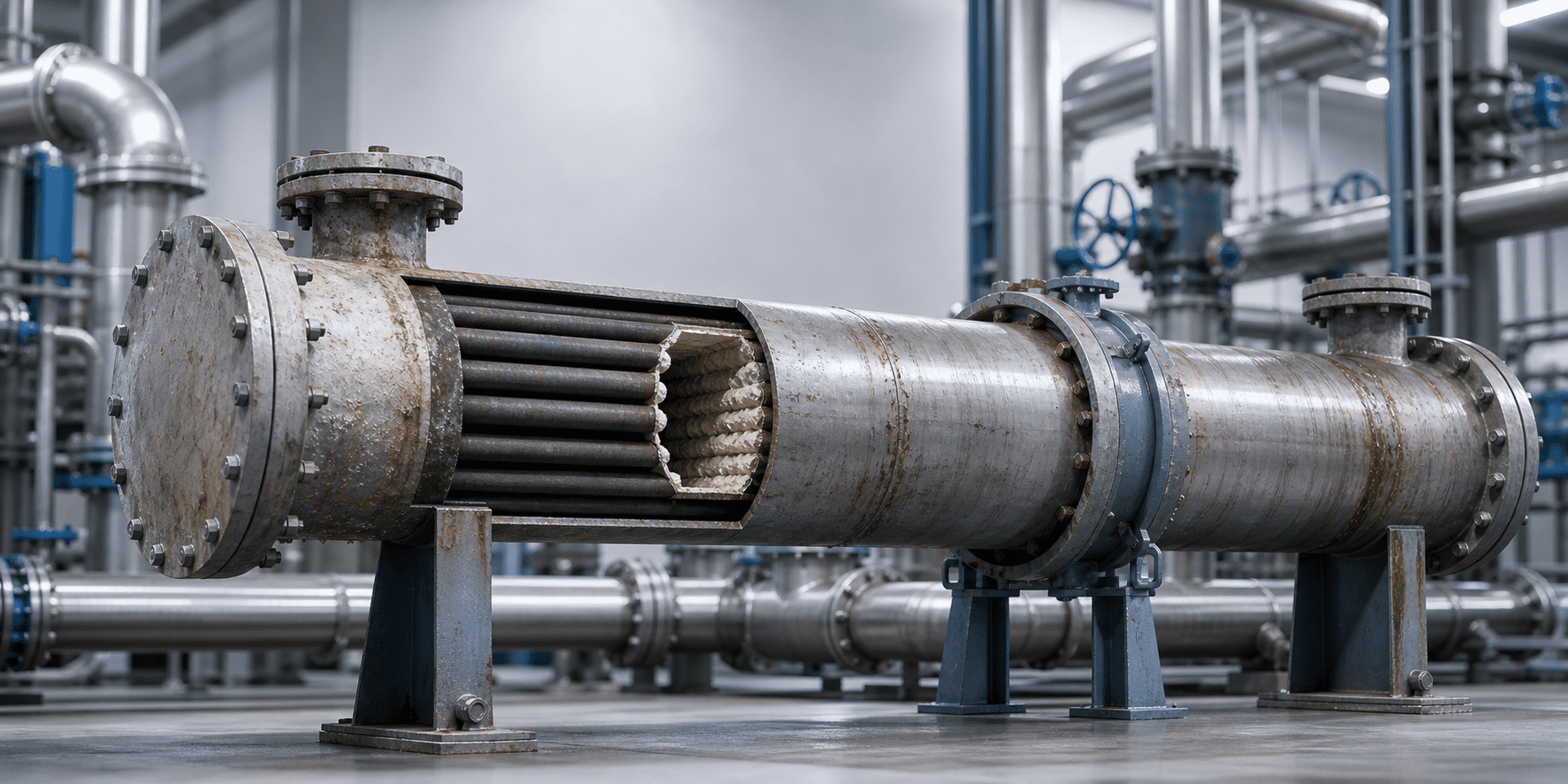
Yes, you should descale an old heat exchanger, but the method you choose matters more than you might think. The real question is not whether to descale, but how to do it without turning a maintenance procedure into an unplanned replacement.
Here is the scenario that keeps facility managers up at night. A shell-and-tube heat exchanger has been running for 11 years in a commercial cooling loop. The approach temperature has crept up 4°C over the past two seasons. Energy costs are climbing. The maintenance team knows there is scale inside. But someone on the team has heard a story about an old unit that sprang leaks the week after an acid cleaning, pinholes that the scale had been plugging for years. So the question sits there, month after month: descale it and risk a leak, or leave it alone and watch efficiency keep dropping?
If that sounds familiar, this heat exchanger descaling guide will give you a clear framework for making the call. We will cover what scale is actually doing to your equipment (spoiler: it is not protecting it), how to assess an aging heat exchanger before you put any cleaning solution through it, and what descaling methods are safest for older metallurgy.
Key Takeaways
Scale buildup is not a protective barrier, it creates under-deposit corrosion that silently destroys metal beneath the scale layer while you cannot see it
The risk of leaving scale in place (hidden corrosion, efficiency loss, eventual failure) almost always outweighs the risk of properly descaling with the right method
Old heat exchangers need a phased approach: assess condition first, use the gentlest effective descaling method, passivate after cleaning, and install ongoing prevention
Physical, chemical-free descaling eliminates the corrosion risk associated with acid cleaning, especially important for aging equipment with unknown metallurgy
A single descaling event typically pays for itself in weeks through energy savings alone; replacing a heat exchanger that could have been saved costs 10-50x more
The Hidden Problem, What Scale Is Really Doing to Your Heat Exchanger
Most maintenance teams think about scale as an efficiency problem. It is that. But it is also something worse.
More Than Just Efficiency Loss
The numbers on scale’s impact are striking. A scale layer of just 1 mm reduces heat transfer efficiency by 10 to 15 percent. At 3 mm, energy costs can climb by up to 38 percent. Across the US and UK economies, heat exchanger fouling costs an estimated $16.5 billion annually in excess energy, lost production, and premature equipment replacement.
But efficiency loss is only the visible part of the problem. The damage you cannot see is what eventually forces a replacement.
Under-Deposit Corrosion, The Damage Hiding Beneath the Scale
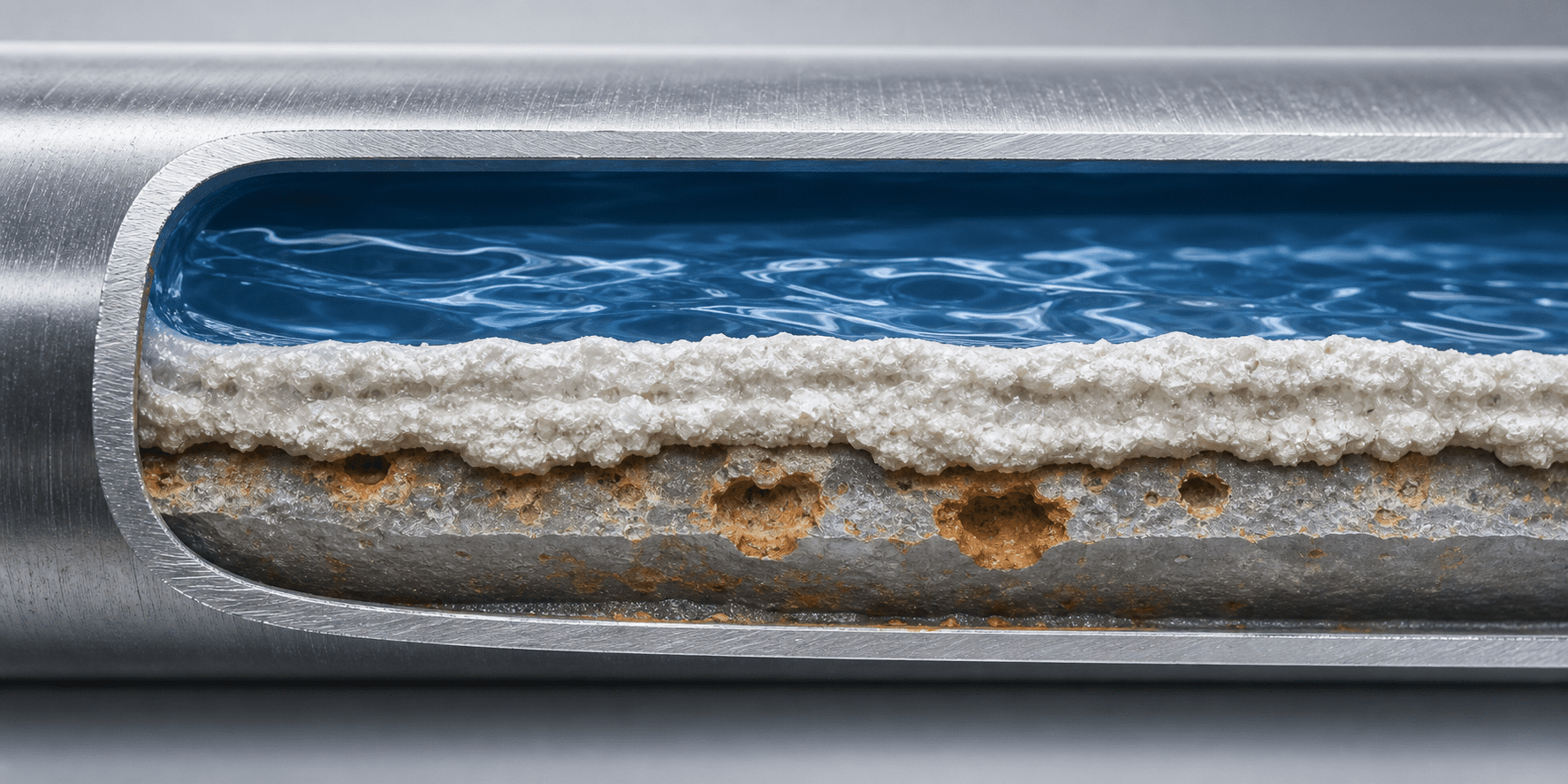
When scale forms on a heat exchanger surface, it does not just sit there inertly. It creates a trapped microenvironment that is chemically different from the bulk water flowing through the system.
Here is how it works. The area under a scale deposit becomes oxygen-depleted compared to the surrounding exposed metal. This creates a differential aeration cell, an electrochemical situation where the metal under the deposit becomes anodic and starts dissolving, while the exposed metal nearby becomes cathodic. Chlorides, sulfides, and acids concentrate in the confined space under the scale, where they cannot be diluted by the flowing water. The result is localized corrosion that eats into the metal directly beneath the deposit, progressing unseen for months or years.
Consider what happened to a seawater-cooled cupronickel condenser at a coastal power station. After two years in service, over half the tubes showed severe pitting corrosion under calcium carbonate and copper chloride deposits. Routine eddy current testing during annual shutdowns had flagged nothing unusual, the scale layer was masking the pits. The leaks appeared suddenly during a routine restart, forcing an unplanned 11-day outage. The root cause was sulfate-reducing bacteria (SRB) thriving in the oxygen-depleted microenvironments under the scale, generating hydrogen sulfide that attacked the tube walls.
When Jim, the facility’s lead engineer, presented the failure analysis to his management team, he put it bluntly: “The scale wasn’t protecting these tubes. It was hiding a corrosion problem we couldn’t see until it was too late.”
This is under-deposit corrosion (UDC), and it is the primary reason why leaving scale in place is riskier than removing it.
The Microbiological Factor
Scale deposits also create an ideal habitat for microbiologically influenced corrosion (MIC). Sulfate-reducing bacteria colonize the stagnant, oxygen-free environment under scale layers, producing hydrogen sulfide as a metabolic byproduct. This accelerates pitting corrosion significantly, and it all happens out of sight, beneath a layer of what looks like ordinary mineral scale.
The Scale-Corrosion Paradox, Does Scale Protect Metal?
There is a persistent belief in some corners of industry that scale acts as a protective barrier against corrosion. The reality is more nuanced, and relying on scale for protection is poor engineering practice.
Where the Idea Comes From
There is a grain of truth. Research published in Advances in Materials Science and Engineering (Vasyliev, G. et al., 2020, “Anticorrosion Behaviour of Calcareous Deposits Formed on Steel Heat-Exchange Surfaces,” doi:10.1155/2020/8695308) documented that a uniform 0.2 mm calcite layer can reduce the general corrosion rate on carbon steel from 0.8 mm per year to below 0.1 mm per year. The dense scale blocks oxygen diffusion to the metal surface, slowing uniform corrosion.
But here is the critical distinction. Uniform corrosion is the kind you can measure, predict, and manage. Localized corrosion, pitting, crevice attack, under-deposit attack, is what causes sudden, catastrophic failure. And scale does not prevent localized corrosion. It promotes it.
The Real-World Truth
Industry research is clear on this point. As Stokes and colleagues noted in their widely cited ASTM publication (Stokes, P. S.N. et al., “Developments in On-Line Fouling and Corrosion Surveillance,” ASTM STP 1292, 1994): “contrary to expectation, the presence of scales or biofilms will often exacerbate damage, not prevent it. Scales or biofilms prevent uniform corrosion and promote localized attack, often in the form of pitting.”
Think of it this way. A uniform, dense scale layer might slow down the type of corrosion you can plan for. But real-world scale is never perfectly uniform. It is patchy, porous, and uneven, and that inhomogeneity is what creates the electrochemical conditions for pitting. The worst possible outcome is thick, non-uniform scale that both reduces heat transfer and creates localized corrosion sites underneath.
The engineering consensus is straightforward: controlled water treatment, scheduled cleaning, and ongoing scale prevention are safer and more predictable than depending on accidental scale buildup for corrosion protection.
What Makes Old Equipment Different

Descaling a 3-year-old heat exchanger is routine maintenance. Descaling a 15-year-old unit is a risk-management exercise. Here is what changes with age.
Pre-Existing Damage You Cannot See
An older heat exchanger carries its history in ways that are not visible from the outside. Years of inconsistent water treatment, pH excursions, and seasonal shutdowns leave behind cumulative effects. The most dangerous of these is pre-existing under-deposit corrosion, pits and wall thinning that have developed beneath scale layers over many operating years.
When you descale, you remove the mineral deposits that may be physically plugging small through-wall defects. The descaling acid does not create the holes. It reveals them. This distinction matters, because it reframes the risk: the question is not whether descaling will damage your equipment. It is whether your equipment is already damaged in ways the scale is hiding.
Maria, a maintenance planner at a pharmaceutical plant, faced this exact situation last year. A 14-year-old stainless steel heat exchanger on a critical process loop was heavily scaled with calcium carbonate and silica. Ultrasonic thickness readings were inconclusive because the scale layer was interfering with the measurements. Her team was divided: half wanted to descale, half wanted to replace.
Maria’s approach is worth following. She had the team take a borescope inspection of accessible tube sections after mechanically removing scale from a small test area. What they found was reassuring, minor surface pitting but no wall loss approaching minimum thickness. They proceeded with a neutral-pH descaler over a weekend shutdown, recovered 92 percent of the lost heat transfer efficiency, and installed a commercial water descaler on the feed line. A year later, the approach temperature is holding steady and the unit avoided a $180,000 replacement.
Material Degradation in Legacy Units
Older heat exchangers may use materials that are not optimal for their current operating conditions. Common examples include 304 stainless steel in cooling water service that should have been 316SS for chloride resistance, or yellow brass with more than 15 percent zinc content that is susceptible to dezincification, a form of dealloying where zinc leaches out of the alloy, leaving a porous, weakened copper structure.
If you are unsure about the metallurgy of an older unit, err toward the gentlest descaling method available. This is where physical, chemical-free descaling has a distinct advantage; there is no acid to react with the base metal, regardless of what alloy you are dealing with.
Assessment Protocol Before You Start
Before circulating any descaling solution through an older heat exchanger, do these four things:
- Borescope inspection of accessible tube interiors and the tube sheet face
- Ultrasonic thickness measurement at multiple points, clean a small test area first for accurate readings
- XRF or wet chemistry analysis of the scale to identify its composition (carbonate, sulfate, silicate, iron oxide)
- Water chemistry review to check for historical chloride levels, pH excursions, and inhibitor residuals
These four data points tell you what you are dealing with and inform which descaling method is appropriate. If your team lacks the in-house capability for borescope or ultrasonic testing, contact our engineering team for guidance on assessment partners in your region.
Want to assess a heat exchanger without risking chemical damage? ScaleDp’s physical water treatment provides continuous descaling and corrosion protection without any chemicals, no metallurgy compatibility concerns, no passivation required. Explore how DPSE technology works
The Descaling Decision Matrix

Here is a practical framework for making the call, organized by equipment condition.
Older unit, no known corrosion, wall thickness within spec
Assessment: Borescope + UT confirm good condition
Recommended Action: Descale with inhibited mild acid (citric/sulfamic) or neutral-pH descaler; inspect after short circulation
Risk Level: Low
Older unit, known corrosion history, wall thickness borderline
Assessment: Prior pitting documented; UT shows some thinning
Recommended Action: Use neutral-pH or physical descaling only; test a small section first; have replacement plan ready
Risk Level: Medium
Heavily scaled, unknown condition, no inspection possible
Assessment: Cannot verify wall thickness under heavy scale
Recommended Action: Descale but approve replacement budget first; cleaning may reveal fatal pitting; but if it does, the unit was already end-of-life
Risk Level: Medium-High
Newer unit (<5 years), routine scaling, regular maintenance history
Assessment: Good condition, known water chemistry
Recommended Action: Standard inhibited descaling as preventive maintenance; install ongoing prevention to extend intervals
Risk Level: Very Low
The hardest scenario is the third one, heavily scaled, unknown condition. Here is a way to think about it: if descaling reveals damage that makes the unit unsafe to operate, that damage was already there. The descaling did not cause it. It exposed it. And exposing it during a planned shutdown, with a budget and a plan in place, is far better than having it expose itself during operation.
How to Descale an Old Heat Exchanger Safely, Methods Compared
The method you choose should match the risk profile of the equipment. Here are your options, from gentlest to most aggressive.
Physical / Chemical-Free Descaling
Physical water treatment works by altering the crystallization behavior of scale-forming minerals without using any chemicals. ScaleDp’s DPSE technology, for example, generates a weak electric current as water flows through the system. This current transforms calcium carbonate from hard, adherent calcite into soft, non-stick aragonite that detaches from surfaces and is carried away by water flow.
The same process simultaneously forms a chelating film on pipe and tube walls that isolates the metal from water and dissolved oxygen, providing corrosion prevention without chemical inhibitors.
Why this matters for old equipment: There is zero chemical risk to the base metal. No acid concentration to calculate. No temperature limits to observe. No passivation step required afterward. The technology works continuously, once installed, it prevents re-scaling and ongoing corrosion without maintenance. For aging heat exchangers where metallurgy may be uncertain or where chemical descaling carries unacceptable risk, physical treatment is the safest first-line option.
ScaleDp reports descaling efficiency of 87 to 95 percent depending on the model, with corrosion prevention rates of 95 percent and an operating lifespan of 10 years with no component replacement.
Neutral-pH Chemical Descaling
For old equipment that needs chemical cleaning, neutral-pH descaling agents (pH 6.0 to 9.0) offer a middle ground. These products use high-efficiency chelating agents combined with corrosion inhibitors to dissolve carbonate scale and iron oxides without the over-corrosion risk and hydrogen embrittlement concerns of traditional acid washing. Many formulations self-passivate after cleaning, eliminating a separate process step.
This is a strong choice for older units where physical descaling alone may not be fast enough but acid descaling is too aggressive.
Inhibited Acid Descaling
Citric acid and sulfamic acid, properly inhibited, are the standard choices for most routine chemical descaling. Citric acid is biodegradable and low-risk. Sulfamic acid handles sulfate and silicate scales effectively at moderate temperatures. Both require corrosion inhibitors formulated for the specific metallurgy.
Key rules for acid descaling old equipment:
- Keep temperature below 60°C (higher temperatures accelerate both descaling and corrosion)
- Start with a short circulation (30 minutes) and inspect before continuing
- Monitor solution pH and color indicators throughout
- Follow immediately with thorough fresh-water flushing and passivation
Hydrochloric Acid, Know the Risk
Hydrochloric acid is highly effective on calcium carbonate but carries the highest corrosion risk. On old equipment with unknown metallurgy, uninhibited HCl should never be used. Even inhibited HCl introduces chloride ions that can cause stress corrosion cracking in stainless steels. Reserve this method for situations where other approaches have been tried and the metallurgy is well-characterized.
Mechanical Descaling
Mechanical descaling uses physical force rather than chemical dissolution to remove deposits. The primary methods include hydro-jetting (high-pressure water at 5,000 to 15,000 psi directed through tube bores), rotary brushing (nylon or stainless steel brushes driven through straight tubes), and mechanical pigging (scrapers or bullet-shaped pigs propelled by compressed air or water).
For old equipment, mechanical descaling offers a key advantage: zero chemical interaction with the base metal. If tube wall thickness is uncertain or metallurgy is unknown, there is no acid to cause pitting, no chloride to trigger stress corrosion cracking, and no passivation required afterward. Hydro-jetting at moderate pressure is the safest mechanical option for fragile tubes; rotary brushing is faster but requires confirming the tubes are straight and the brush material is compatible with the tube alloy.
The trade-off is reach. Mechanical methods work well on straight-tube heat exchangers with accessible bores but cannot clean the internal passageways of plate-and-frame or brazed plate exchangers, where circulating chemical or physical treatments are the only practical options. For heavily scaled shell-and-tube bundles, many maintenance teams use a combination approach: mechanical pre-cleaning of accessible tube interiors, followed by chemical or physical treatment to address deposits in U-bends, return headers, and other inaccessible areas.
Already managing a chemical descaling program? Adding ScaleDp after cleaning breaks the clean-foul-clean cycle. Install it on the feed line, and the DPSE technology prevents scale from re-forming while protecting against corrosion, 10 years, no maintenance.
After Descaling, Breaking the Cycle

A heat exchanger that gets descaled without follow-up prevention will scale again. The clean-foul-clean cycle is expensive: each descaling event costs hundreds to low thousands in chemicals, labour, and downtime, and each cycle exposes the equipment to cumulative risk.
Prevention Options Compared
Chemical scale inhibitors require continuous dosing, monitoring, and adjustment. They work, but they add ongoing operational cost and complexity. Water chemistry upsets, a missed dose, a pump failure, a bulk chemical quality issue, create windows where scaling resumes.
Ion-exchange water softening removes calcium and magnesium but does not address corrosion. It produces salt-laden waste brine, requires regeneration cycles, and adds system complexity.
Physical water treatment (ScaleDp) installs inline on the feed and requires no chemicals, no monitoring, and no maintenance for its 10-year service life. It addresses both sides of the problem, preventing scale formation and inhibiting corrosion, through a single passive device. For facilities where maintenance bandwidth is limited, this simplicity has particular value.
Monitoring After Descaling
Proper heat exchanger descaling should restore performance close to design specifications. Establish these baselines immediately after a successful descaling and track them quarterly:
- Approach temperature at design flow rate, a rise of more than 2-3°C from post-cleaning baseline signals re-scaling
- Pressure drop across the heat exchanger, an increase of more than 10 percent from baseline warrants investigation
- Energy consumption of associated pumps and heating/cooling equipment, an unexplained increase of 3 percent or more often traces back to fouling
- Annual ultrasonic thickness check on older units, schedule these during planned shutdowns; trending wall loss over time is more informative than a single reading
For heat exchanger corrosion monitoring specifically, tracking these indicators alongside the thermal performance data gives you early warning of conditions that lead to under-deposit attack. A deviation from baseline triggers investigation before the problem compounds into an unplanned outage.
The Economics, Heat Exchanger Descaling vs Replacement
The financial case for descaling is almost always compelling. When weighing heat exchanger descaling vs replacement, the question is rarely whether descaling pays for itself, it is how quickly.
The Cost of Doing Nothing
The US Department of Energy has documented that just 1/32 inch (0.8 mm) of scale causes approximately 2 percent fuel loss in a fired system. For a continuously operating industrial heat exchanger, that 2 percent penalty can translate to $50,000 to $90,000 per year in excess energy cost for a single unit, far more than the cost of descaling.
Across a facility with a dozen or more heat exchangers, the cumulative energy penalty of unaddressed scaling can reach hundreds of thousands of dollars annually.
Descaling ROI
A typical chemical descaling event for a medium-sized shell-and-tube exchanger costs several hundred to a few thousand dollars in materials and labour, done over one to two shifts. The energy savings from restored heat transfer efficiency pay that back in weeks, sometimes days for large units operating continuously.
When Replacement Makes Sense
Descaling cannot fix mechanical failure. Replacement is the right call when:
- Ultrasonic testing shows tube wall thickness below 80 percent of design minimum
- Descaling frequency exceeds twice per year, the cumulative cost and downtime suggest a redesign
- An upgraded heat exchanger design (spiral, self-cleaning geometry) offers payback under three years through reduced fouling
- Tube material is obsolete for current water chemistry (example: 304SS where chlorides are present)
For most aging heat exchangers that have been well-maintained, descaling plus ongoing prevention buys years of additional service life at a fraction of replacement cost.
Frequently Asked Questions
Does descaling an old heat exchanger cause leaks?
No, but it can reveal leaks that already existed. Under-deposit corrosion creates pits and pinholes beneath scale layers. The scale may be physically plugging these defects. When descaling removes the mineral deposit, pre-existing damage becomes visible. This is why assessment (borescope, ultrasonic testing) before descaling is essential. If the unit has through-wall defects, you want to discover that during a planned maintenance window, not during operation.
Can scale act as a protective layer against corrosion?
Under specific, controlled conditions, a thin, uniform, dense scale layer can slow uniform corrosion by blocking oxygen diffusion. But real-world scale is almost never uniform; it is patchy and porous, and that inhomogeneity creates electrochemical conditions that promote localized pitting. The industry consensus is that controlled water treatment is safer and more predictable than relying on accidental scale for protection.
What is the safest descaling method for old equipment?
Physical, chemical-free descaling is the safest option because it introduces no acid, requires no metallurgy compatibility verification, and needs no post-cleaning passivation. For chemical methods, neutral-pH descaling agents (pH 6.0-9.0) with built-in corrosion inhibitors are the gentlest chemical approach. Inhibited citric acid is the next tier, suitable when metallurgy is known and wall thickness is confirmed adequate.
How often should heat exchangers be descaled?
For most commercial and industrial systems, annually at minimum. In hard water areas or high-temperature service, every 3 to 6 months. The best practice is condition-based scheduling: monitor approach temperature and pressure drop, and descale when performance drifts 5 percent or more from baseline rather than waiting for a fixed calendar date.
Is chemical-free descaling effective on heavy scale buildup?
Yes, but the time frame differs from acid cleaning. Physical descaling works gradually, with results typically visible within 7 to 15 days for residential-scale equipment and 30 to 45 days for larger commercial and industrial systems. For extremely heavy scaling, a combination approach (mechanical pre-cleaning of accessible surfaces, followed by ongoing physical treatment) often delivers the best outcome.
How do I know if my heat exchanger is too old to descale?
Age alone is not the deciding factor. A 20-year-old heat exchanger with consistent water treatment, good wall thickness readings, and no pitting history can be descaled safely. A 7-year-old unit with documented corrosion, wall thinning, and uncertain water chemistry may be a candidate for replacement. The assessment protocol described above, borescope, ultrasonic testing, scale analysis, water chemistry review, gives you the data to make that call.
The Bottom Line
Descaling an old heat exchanger is not a gamble when you approach it methodically. Assess the condition. Match the method to the risk. Plan for what the cleaning might reveal. And once the unit is clean, install ongoing prevention so you are not back in the same position next year.
The most expensive choice is doing nothing. Scale does not protect your equipment. It degrades efficiency, hides corrosion, and eventually forces the replacement you were trying to avoid. A properly executed descaling, especially with a method suited to the age and condition of the equipment, extends asset life, recovers lost efficiency, and costs a fraction of what a failure costs.
For aging heat exchangers where chemical risk is a concern, physical, chemical-free descaling eliminates the acid compatibility question entirely. ScaleDp’s DPSE technology removes existing scale, prevents new scale from forming, and provides ongoing corrosion protection, all without chemicals, without maintenance, and without putting 10-year-old metallurgy at risk.
Explore ScaleDp Industrial Descaling Solutions
Published: June 12, 2026 | Author: Michael Chen, P. Eng, Senior Applications Engineer, ScaleDp | Reviewed by ScaleDp Engineering Team
References
- Vasyliev, G. et al. (2020). “Anticorrosion Behaviour of Calcareous Deposits Formed on Steel Heat-Exchange Surfaces.” Advances in Materials Science and Engineering, vol. 2020, Article ID 8695308. doi:10.1155/2020/8695308
- Stokes, P. S.N. et al. (1994). “Developments in On-Line Fouling and Corrosion Surveillance.” ASTM STP 1292, American Society for Testing and Materials.
- U. S. Department of Energy. “Minimize Fouling of Heat Exchanger Equipment.” Steam Tip Sheet #7.
- Zubair, S. M., Sheikh, A. K. et al. “A Risk-Based Performance Analysis of Plate-and-Frame Heat Exchangers Subject to Fouling: Economics of Heat Exchanger Cleaning.” Heat Transfer Engineering, 2004.



