Industrial Water Descaler
The whole-house water descaler provides chemical-free scale protection for all water outlets, preventing limescale buildup, improving efficiency, and extending system lifespan.
Industrial Water Descalers
Select the Right Industrial Model
Compare industrial applications, nominal pipe diameter and recommended flow for boilers, chillers, heat exchangers, cooling towers, condensers, RO systems, power plants and process pipelines.
ID001
Boiler scale inhibitor designed for boiler feed and recirculating water lines.
- ConnectionFlange
- Nominal SizeDN32
- Max. Flow8 m³/h
- Recommended4 m³/h
ID002
Scale-control unit for industrial chiller condenser and chilled-water circuits.
- ConnectionFlange
- Nominal SizeDN40
- Max. Flow12 m³/h
- Recommended7 m³/h
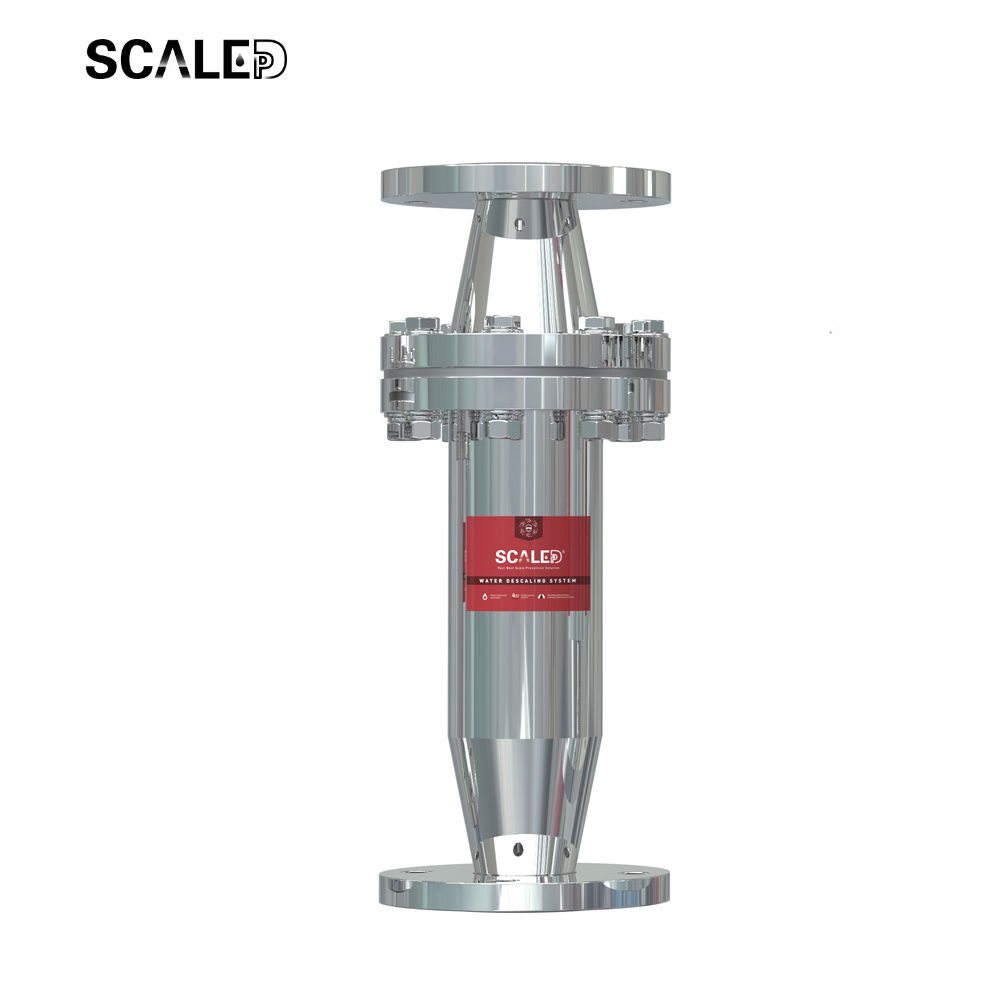
ID003
Physical scale inhibition for heat exchangers and high-temperature transfer surfaces.
- ConnectionFlange
- Nominal SizeDN50
- Max. Flow20 m³/h
- Recommended10 m³/h
ID004
Cooling-tower scale control for open and closed circulating-water loops.
- ConnectionFlange
- Nominal SizeDN65
- Max. Flow35 m³/h
- Recommended18 m³/h
ID005
Condenser water scale inhibitor for HVAC, refrigeration and process cooling systems.
- ConnectionFlange
- Nominal SizeDN80
- Max. Flow50 m³/h
- Recommended27 m³/h
ID006
Pre-treatment scale inhibitor for industrial reverse-osmosis feedwater systems.
- ConnectionFlange
- Nominal SizeDN100
- Max. Flow80 m³/h
- Recommended42 m³/h
ID007
High-flow scale control for power-plant circulating and auxiliary water networks.
- ConnectionFlange
- Nominal SizeDN125
- Max. Flow120 m³/h
- Recommended66 m³/h
ID008
Large-bore scale inhibitor and descaler for industrial process and transfer pipelines.
- ConnectionFlange
- Nominal SizeDN150
- Max. Flow180 m³/h
- Recommended95 m³/h
DPSE TECHNOLOGY
The DPSE filter element is made from nine alloy metals, including copper and zinc, using a high-temperature melting process. As water flows through the filter, it releases free electrons that polarize water molecules. This changes scale from hard calcite to soft aragonite, causing existing scale to detach while preventing Ca²⁺, Mg²⁺, CO₃²⁻, and OH⁻ from forming new scale.
Limescale Removal Process
Scale inhibition starts immediately when water flows through the ScaleDp water descaler. After 5–10 minutes of operation, the effect becomes stable. Descaling begins approximately 72 hours after installation. As shown in the diagram, stubborn limescale gradually transforms from calcite into soft aragonite. From Day 1 to Day 15, the descaling effect increases steadily, and after about 28 days, the scale layer becomes very easy to rinse away.
Effect on calcite crystals under microscope. Picture 0 – not treated water, pictures 1, 2, 3 – water treated with DPSE.
Water Quality Requirements
Embrace the opportunity to design with dark border style.
≤1500mg/l
Hardness
3-10
PH
≤10000mg/l
Salinity
≤200000ppm
TDS
<5mg/L
IRON
Top Partner
Wax crystallization in oil pipelines can cause blockages, restrict crude flow, increase pressure, and lead to frequent shutdowns and high maintenance costs, seriously affecting production.
Our equipment, successfully applied in CNPC and Sinopec projects, can:
Inhibit wax formation to reduce blockages
Remove existing deposits to restore flow efficiency
Lower energy and maintenance costs
Ensure stable, efficient oil and gas transport
Proven in real-world applications, our solution provides a safe, reliable, and high-performance pipeline environment.
CASS 1
CASS 2
CASS 3
Case Study: Scale Control in the Third Oil Production Plant’s Water Injection Heating Pipelines
Background:
The water injection heating pipelines in the Third Oil Production Plant’s gathering and transportation system were experiencing severe scaling, leading to a reduced effective pipe diameter and impacting overall oilfield production. The scaling was mainly concentrated at the outlet of the combined heating furnace at the oil transfer and water discharge station and in the external pipelines from the valve assembly to the metering station.
Severe scaling caused insufficient pump inlet pressure, reducing pump efficiency and hindering normal operations. In particular, in the transitional zone, the poor crude oil properties exacerbated pipeline scaling, affecting water injection pressure and return oil temperature, which increased backpressure and ultimately reduced production.
Solution:
Based on on-site assessment, two fully intelligent anti-scale, de-scaling, and anti-wax carbon devices were installed.
Results:
After installation, the system operated smoothly, and all technical indicators met the expected outcomes. The devices effectively prevented scale formation in the water injection heating pipelines, continuously improving pipeline efficiency, reducing production costs, minimizing pipeline perforation and pressure drop due to severe scaling, reducing labor intensity, and ensuring safe oilfield operations.