
Pipe scale can build up inside PVC pipes and contribute to serious pipe blockage. Plastic does not rust like iron, but minerals carried by water can still settle, crystallize, and accumulate on its inner surface. A pipe can therefore look sound from the outside while its usable opening becomes smaller.
For property owners, installers, and water treatment companies, this matters: choosing PVC does not remove the need to assess water chemistry and inspect recurring restrictions. The photographs below illustrate why the inside of a pipe deserves as much attention as its material.
Why PVC Pipes Can Develop Pipe Scale
Corrosion resistance and resistance to mineral deposits are different properties. PVC provides a surface for water to contact; it does not remove dissolved calcium or change the supply’s scaling potential.
When water becomes supersaturated with a mineral such as calcium carbonate, crystals can form and grow. Some deposits develop on surfaces, while others arrive as particles from upstream. As a result, a smooth plastic bore can gradually acquire a rough coating.
Published evidence supports this distinction. A 2022 study of a drinking-water network examined deposits from PVC and asbestos pipes using microscopy and X-ray diffraction. Researchers identified calcium carbonate and silica-containing deposits. These findings demonstrate that PVC can host mineral accumulation; they do not establish the composition of the deposits in our photographs.
What the Pipe Inspection Photos Show
The images supplied for this article show pipework identified as PVC and internal inspection views. They provide visual context for deposit investigation. We do not have a dated inspection report, measured deposit thickness, water analysis, or laboratory identification for this installation.

The first image shows a cable entering an open fitting. The next internal view shows discoloration and material along the lower surface. This is a reason to investigate, rather than assume that every visible deposit is limescale.
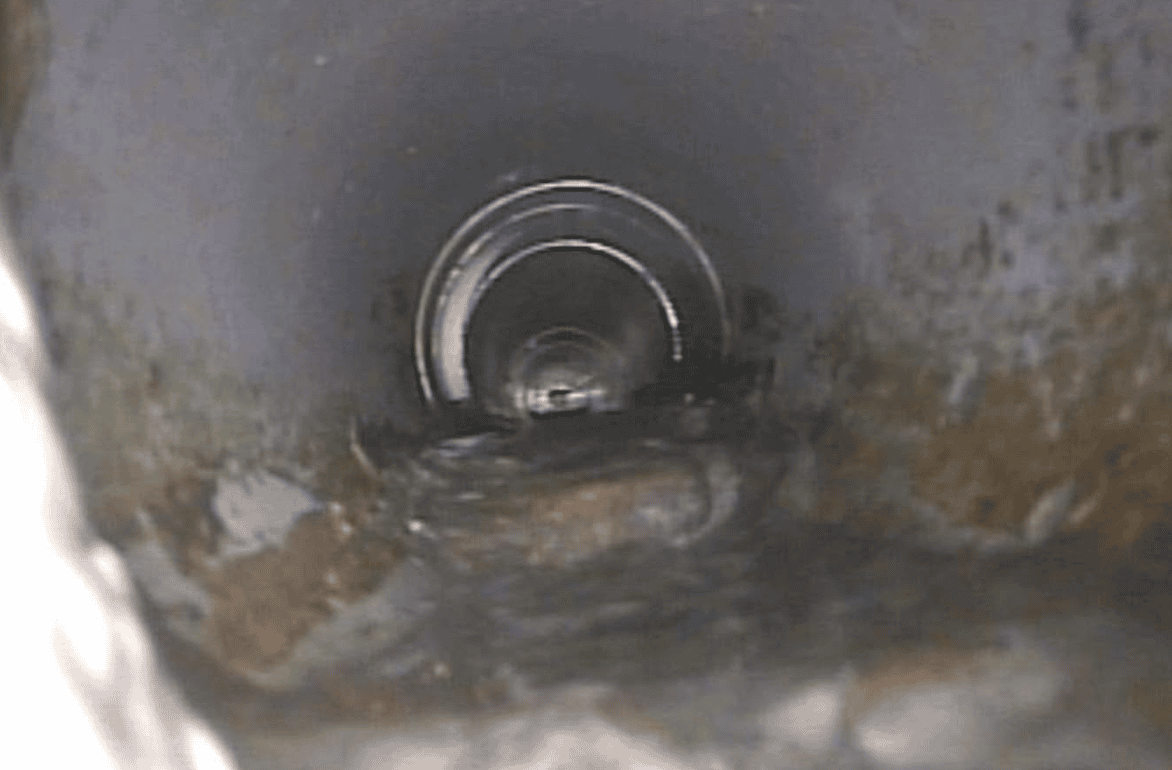
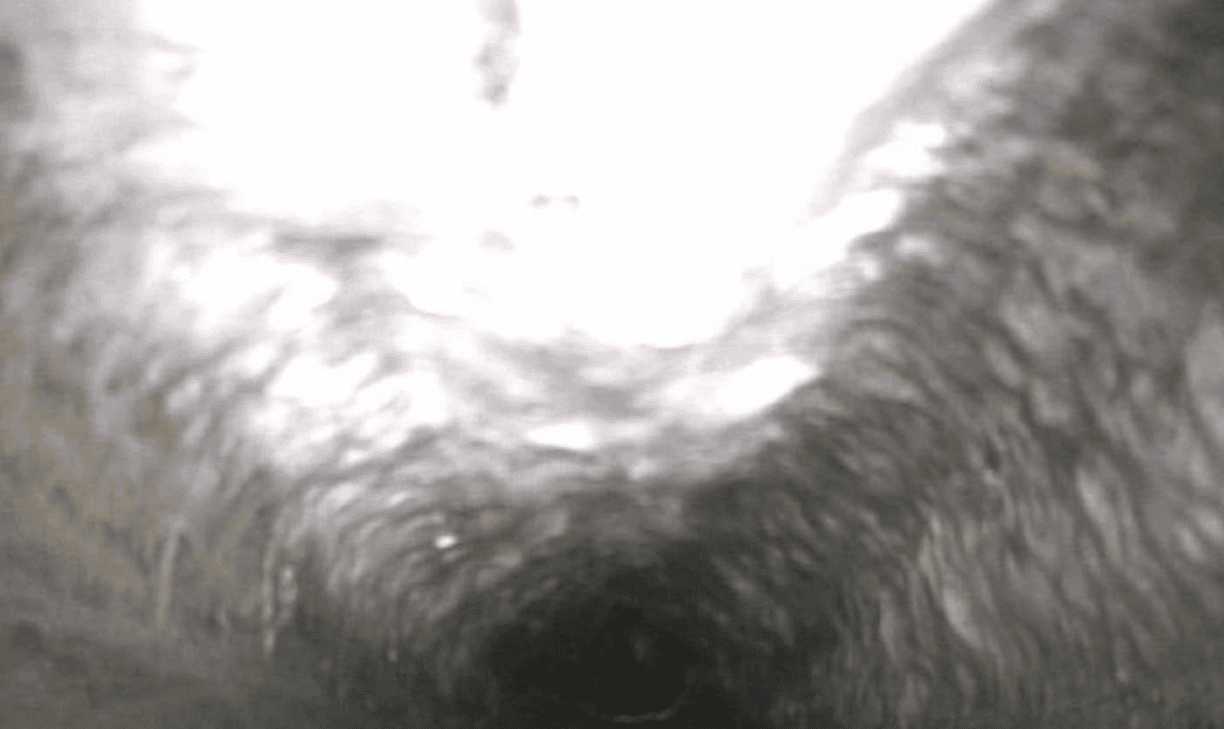
The closer views show irregular, pale deposits around portions of the pipe wall. However, camera perspective and lighting prevent reliable measurement of the remaining opening. These images are inspection examples, not a verified before-and-after treatment sequence.

What Causes Pipe Scale to Grow?
Water hardness is a useful starting point, but it cannot predict every scaling problem. Two systems with similar hardness may accumulate different deposits because their operating conditions differ.
| Factor | Why it matters | What to check |
|---|---|---|
| Calcium, alkalinity, and pH | Together they influence calcium carbonate saturation. | A water analysis, not just a TDS reading |
| Temperature and carbon dioxide loss | Heating or gas exchange can shift carbonate chemistry toward precipitation. | Actual water temperature and changes along the system |
| Flow and pipe layout | Transport, settling, and contact with surfaces affect deposit patterns. | Low points, poorly draining sections, and changing demand |
| Suspended solids and wastewater constituents | Mixed deposits can combine mineral and non-mineral material. | Sediment, grease, organic matter, and the source of the discharge |
For example, an experimental study of tunnel drainage systems documented calcium carbonate deposition on PVC. Its drainage conditions differ from household plumbing, but it provides another direct example of scaling on plastic. Pipe material alone cannot determine the outcome.
Cold systems also deserve attention. Our guide to scale buildup in cold-water pipes explains why heating is not a requirement for every deposit.
How Pipe Scale Can Lead to Pipe Blockage
As pipe scale thickens, it reduces the available opening and changes the surface that water flows over. Rough deposits may also catch debris. Consequently, a restriction can become a combined problem involving both mineral buildup and trapped material.
Consider a purely illustrative example: a pipe with a 50 mm internal diameter develops a uniform 5 mm deposit. Its remaining diameter is 40 mm, leaving 64% of the original cross-sectional area. That is a 36% area loss, not a prediction of an identical reduction in flow.
In pressurized supply pipes, restrictions increase pressure loss during use and can weaken outlet flow. In gravity drains, deposits can reduce carrying capacity and encourage backups. Our article on limescale and household water pressure explains the supply-side distinction.
Diagnose Pipe Blockage Before Choosing Treatment
A slow drain or weak tap does not prove that pipe scale is responsible. Grease, construction debris, damaged fittings, poor drainage slope, and upstream valve problems require different remedies.
- Identify the service. Confirm whether the line carries drinking water, process water, or wastewater.
- Locate the restriction. Record affected sections, operating symptoms, and camera inspection positions.
- Identify the deposits. Combine inspection with water testing; use laboratory analysis when composition changes the cleaning or treatment decision.
- Restore capacity. Choose cleaning or replacement methods compatible with the pipe, joints, seals, and service.
- Check recurrence. Record flow or drainage performance after cleaning, then compare later inspections under similar conditions.
Ask a qualified contractor to assess severe pipe blockage. Aggressive scraping or unsuitable cleaning chemicals can damage components. PVC compatibility alone is insufficient because fittings and seals may have different limits. Never mix drain-cleaning chemicals.
Where ScaleDp Fits in a Pipe Scale Prevention Plan
After confirming a recurring mineral-scale problem in the water supply, consider prevention alongside necessary repairs. ScaleDp offers physical scale inhibition designed to influence mineral crystallization and reduce hard-scale adhesion, without salt regeneration, chemical dosing, or external electrical power.
According to the manufacturer’s DPSE technology explanation, flowing water interacts with a multi-alloy core. The treatment targets deposit behavior while retaining hardness minerals. Performance therefore needs evaluation through deposit and maintenance observations, rather than expecting a lower hardness reading.
A whole-house ScaleDp unit may suit an incoming-water application after water-quality and sizing checks. Larger projects can review commercial water descaler options. However, supply-water treatment does not resolve grease, poor drain layout, or mineral-forming constituents added downstream.
The supplied photographs do not demonstrate ScaleDp performance. Existing severe obstructions need their own repair plan, and any proposed treatment should match the actual water chemistry, flow, and service conditions.
Common Questions About PVC Pipe Scale
Does PVC prevent limescale?
No. PVC avoids iron rust from the pipe wall, but minerals in the water can still form deposits on plastic surfaces.
Can a camera confirm the type of scale?
A camera helps locate and describe deposits. It cannot reliably distinguish calcium carbonate, other minerals, and mixed fouling without supporting evidence.
Will replacing a blocked pipe stop recurrence?
Replacement restores the affected section, but deposits can return if the underlying water or drainage conditions remain unchanged.
Plan Beyond the Next Pipe Cleaning
PVC is a pipe-material choice, not a guarantee against pipe scale. Understanding what enters the line, what deposits inside it, and why blockage returns leads to better maintenance decisions.
Work with your local plumbing or water treatment professional to investigate the problem. Distributors, contractors, and project buyers can request ScaleDp application and sizing support. Share the pipe service, water analysis, flow rate, and inspection findings so the proposed solution addresses the actual cause.



