
1. How Cooling Tower Scale Promotes Legionella Growth
The relationship between scale and Legionella in cooling towers is direct and well-documented: mineral deposits roughen surfaces, allowing bacteria to attach; biofilm forms a protective matrix over the scale; protozoan hosts congregate within this matrix; and Legionella replicates inside these hosts before being released into the circulating water. Scale buildup inside cooling towers not only reduces efficiency but also provides the physical foundation for Legionella colonization, replication, and spread. Effective cooling tower scale prevention breaks this chain at its first link.

In August 2025, two cooling towers in Harlem, New York, became the source of one of the most severe Legionnaires’ disease outbreaks in recent years. A total of 114 people were infected, 90 of whom required hospitalization. Investigations revealed that poor water management had allowed scale and biofilm to accumulate unchecked in these towers. Chemical biocides were applied inconsistently and could not penetrate the protective layers that had formed.
You are likely already aware of the importance of cooling tower water treatment. You monitor pH, check conductivity, and dose biocides on schedule. However, if scale has accumulated anywhere in your system, the effectiveness of those biocides is significantly reduced.
This article will explain in detail how scale promotes Legionella growth, why chemical-only approaches often fail to reach bacteria embedded within the scale-biofilm matrix, and how new regulations are raising compliance requirements.
Key Takeaways
- Scale provides the attachment foundation for biofilm—the protective host environment for Legionella; without scale control, biocide programs operate less effectively.
- Over 90% of bacteria in cooling water systems reside within biofilms, not freely suspended in the bulk water; chemical biocides often cannot penetrate the scale-biofilm barrier.
- New York City’s Local Law 159, effective May 7, 2026, mandates monthly Legionella culture testing (up from quarterly), and other jurisdictions are following with stricter requirements.
- Physical water treatment technologies can simultaneously prevent scale formation and inhibit bacterial growth, reducing chemical dependence and providing continuous protection.
- An integrated approach combining physical scale prevention, biocide management, dead-leg elimination, and documented testing meets ASHRAE 188 requirements while lowering operational costs.
2. The “Three-Way Threat” Inside Every Cooling Tower
Cooling towers create the perfect environment for three interconnected problems: scale, biofilm, and Legionella. Each is dangerous on its own, but together they form a self-reinforcing cycle that most treatment programs fail to break—making effective cooling tower scale control the foundation of any reliable Legionella prevention strategy.
2.1 Scale: The Physical Foundation
As water evaporates in cooling towers, dissolved solids become concentrated. Calcium, magnesium, and silica precipitate and form hard mineral deposits on heat exchanger surfaces, fill media, and piping. Just 1 mm of scale can reduce heat transfer efficiency by 10%–50%, directly increasing energy consumption.
More critically than energy loss, scale provides favorable conditions for bacterial growth. Deposits create microscopically rough surfaces. Smooth pipe walls resist bacterial attachment, while scaled surfaces offer thousands of anchor points per square inch.
2.2 Biofilm: The Protective Shield
Once bacteria attach to scaled surfaces, they secrete extracellular polymeric substances (EPS), a sticky, gel-like matrix that forms the structural basis of biofilm. The biofilm grows over and through the scale, creating a multi-layered composite structure.
Biofilm is remarkably efficient. A layer as thin as 0.2 mm can cost a 300-ton chiller over $8,000 per year in additional energy. More importantly, biofilm acts as a diffusion barrier: oxidizing biocides such as chlorine and bromine are consumed by the outer layers before reaching the live bacteria embedded deeper within.
2.3 Legionella: The Hidden Danger
Legionella pneumophila thrives in water between 25°C and 45°C, the typical operating range of cooling towers. The bacteria generally do not multiply freely in the water column; instead, they replicate inside protozoan hosts that graze on biofilms. When these protozoa colonize biofilm-covered, scaled surfaces, they create concentrated reservoirs of Legionella.
Under the right conditions, Legionella are released from the biofilm back into the circulating water. Cooling tower drift eliminators are not designed to capture individual bacteria. Contaminated aerosols can travel considerable distances—viable Legionella have been detected up to 200 meters from the source tower, and modeling suggests aerosols can reach populations as far as 10 kilometers under favorable wind conditions.
3. The Science: How Scale Directly Enables Legionella Proliferation
Understanding the full pathway from scale to Legionella exposure shows that scale control is not a secondary concern to microbial control—it is a prerequisite.
Step 1: Scale Roughens Surfaces, Bacteria Attach
New cooling tower piping and fill surfaces are relatively smooth. As scale precipitates and accumulates, microscopic peaks, valleys, and crevices form. Particles smaller than 5–6 microns, including individual bacterial cells, lodge in these irregularities. Once anchored, bacteria begin producing EPS, initiating biofilm formation.
Step 2: Biofilm Forms Over Scale, Creating a Protective Matrix
The EPS matrix grows rapidly. Within days, a mature biofilm can be 4–5 times thicker than the scale itself, forming a physical barrier against biocides. Research shows that oxidizing agents such as chlorine are consumed by reactions with organic matter in the outer biofilm layers, leaving the bacteria at the base largely unaffected.
Step 3: Protozoan Hosts Colonize the Biofilm
Biofilms attract protozoa such as amoebae and ciliates that feed on the bacteria within the matrix. Vermamoeba vermiformis and Acanthamoeba species are commonly found in cooling tower biofilms. These protozoa serve as natural hosts for Legionella.
Step 4: Legionella Replicates Inside Protozoa, Then Releases
Legionella can survive and replicate within protozoan cells, the same mechanism that makes it pathogenic in human lung macrophages. A single Legionella cell can produce dozens of progeny inside a host. When the host cell ruptures, the bacteria are released back into the water. In cooling towers rich in scale and biofilm, this cycle runs continuously.
Step 5: Contaminated Aerosols Spread Beyond the Tower
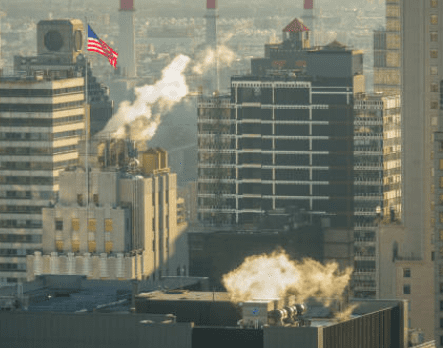
Cooling towers generate fine water droplets during normal operation. Drift eliminators reduce but do not completely prevent aerosol release. Bacteria released from biofilms enter these aerosols.
A 2024 study in Quebec analyzed 105,463 monthly Legionella test results from 2,852 cooling towers and found that 10% of samples exceeded 10,000 CFU/L. Peak concentrations above 100,000 CFU/L were identified as the primary driver of public health risk.
4. Why Chemical-Only Treatment Often Fails Once Scale Accumulates
Over 90% of bacteria in engineered water systems reside within biofilms. Oxidizing biocides react immediately with organic matter. By the time they penetrate 100–200 microns of biofilm and scale, the residual concentration is often near zero, allowing bacteria at the base to survive and rapidly repopulate.
Scale is not only a physical barrier—it is chemically reactive. Iron released from corrosion beneath scale consumes chlorine. Calcium carbonate scale raises the local surface pH, reducing the effectiveness of chlorine (which works best at pH below 8.0). Each additional millimeter of scale effectively neutralizes a portion of the biocide before it can reach its target.

An experienced water treatment engineer, James Hartley, explained: “When we took over the water treatment program at a 500-ton commercial cooling tower in Phoenix, the previous provider had been dosing chlorine at standard rates for three years. Legionella tests kept coming back positive. When we opened the tower, we found a half-inch layer of scale and biofilm covering the fill, with chlorine being consumed only at the outermost layer and leaving the interior completely untouched.”
The facility switched to an integrated program: removing existing scale from the equipment and implementing scale prevention. Three months later, Legionella counts dropped from over 1,000 CFU/L to below detection limits. The key was not using more chemicals, but removing the scale that was protecting the bacteria.
5. The Regulatory Landscape: Why Scale Control Is Now a Compliance Issue
Starting in 2026, regulations governing cooling tower operation have tightened significantly, and scale management is now directly linked to Legionella risk management nationwide.
5.1 ASHRAE 188 and Water Management Plans
ASHRAE 188 requires all commercial buildings with cooling towers to maintain a documented Water Management Plan (WMP) that identifies hazardous conditions, sets control limits, and defines corrective actions. Scale control is explicitly listed as a critical element. Your WMP must document how scale is being prevented, monitored, and remediated—not just chemical parameters.
5.2 NYC Local Law 159: Monthly Testing Begins May 2026
Effective May 7, 2026, New York City’s Local Law 159 mandates monthly Legionella culture testing for cooling towers, up from the previous quarterly schedule. The law was passed in direct response to the Harlem 2025 outbreak. It also strengthens requirements for disinfectant residual monitoring, mandates trained personnel, and requires auditable compliance records to be available within 24 hours.
5.3 Healthcare Facilities Face the Highest Stakes
Since 2017, CMS has required all Medicare and Medicaid facilities to maintain ASHRAE 188-compliant WMPs. Cooling towers at healthcare facilities are classified as high-risk regardless of operating conditions because the patient population includes immunocompromised individuals. States including New York, California, Maryland, and New Jersey have requirements that exceed ASHRAE 188 minimums. Penalties for non-compliance range from fines to facility certification loss.
6. How ScaleDp Disrupts the Scale–Biofilm Cycle
ScaleDp’s physical DPSE water treatment technology offers a non-chemical approach to water management. These systems intervene at the crystallization stage of scale formation. Instead of calcium and magnesium ions forming hard, adherent calcite crystals, they produce soft aragonite particles that remain suspended in the water and are removed through blowdown.
Without scale formation, the physical foundation for biofilm attachment disappears, effectively breaking the first link in the chain.
The DPSE technology goes further. A weak electric current generated in the treatment chamber exceeds the cellular bioelectric potential of bacteria and algae, disrupting cell division, inhibiting enzyme activity, and preventing biofilm establishment—all without chemicals. This mechanism differs fundamentally from chemical oxidation: while biocides must physically contact each cell, the electrochemical effect creates a hostile environment throughout the treated water volume, affecting all cells without needing direct contact.
Chemical Biocides vs. Physical DPSE Treatment
| Factor | Chemical Biocides Only | Physical + Chemical Integrated |
| Scale prevention | Requires additional chemical inhibitors | Continuous physical prevention |
| Biofilm penetration | Limited, consumed by outer layers | Prevents biofilm establishment |
| Dead leg protection | None | Passive protection throughout system |
| Chemical handling | Hazardous storage and dosing equipment | Reduced or eliminated |
| Monitoring burden | Daily residual checks required | Reduced monitoring frequency |
| Environmental discharge | Chemical-laden blowdown | Clean blowdown |
| Regulatory compliance | Meets minimum requirements | Exceeds requirements with documentation |
7. Measurable Results Across Industrial Cooling Systems
ScaleDp industrial physical water descalers provide:
- Up to 95% scale removal efficiency in treated systems
- Effective inhibition of biofilm formation
- Zero chemical discharge in blowdown water
- 10-year operational lifespan with no component replacement
- Effective operation in water with TDS up to 200,000 ppm



