
Tubular Heat Exchanger Milkstone and Water Scale Prevention for Dairy Processing
In dairy processing, mineral deposits in tubular heat exchangers can combine water hardness scale with milkstone, reducing heat transfer and shortening CIP intervals.
Use ScaleDp ID003 to support active descaling, scale prevention, anti-corrosion protection, and rust-reduction while tracking site metrics such as pressure, flow, temperature, cleaning interval, and visible deposits.
Upload your tubular exchanger specs, water report, and CIP trend to evaluate suitability.
Scale-control background for Dairy Processing Tubular Heat Exchanger
Continuous or batch dairy heating with hot water loops, product-side tubular exchangers, CIP, and strict hygiene requirements.
Process stage
Pasteurization, UHT preheating, hot water loop, CIP heating, product heating
Expected result
Use ScaleDp ID003 to support active descaling, scale prevention, anti-corrosion protection, and rust-reduction while tracking site metrics such as pressure, flow, temperature, cleaning interval, and visible deposits.
Common symptoms before selecting a scale-control solution
Dairy exchanger deposits can be product-side milkstone, water-side carbonate scale, protein fouling, or CIP control issues. Identify the side and deposit before treatment.
Heat transfer declines
Possible cause: Water-side scale or product-side milkstone insulates tube surfaces
How to confirm: Compare utility temperatures, product outlet, and flow at steady load
Next step: Determine whether deposit is water-side or product-side
Pressure drop increases
Possible cause: Deposit narrows product or utility passages
How to confirm: Trend pressure drop before and after CIP
Next step: Inspect exchanger side affected by deposit
CIP interval shortens
Possible cause: Mineral and organic deposits build faster than cleaning program can manage
How to confirm: Review CIP conductivity, temperature, time, and visual inspection
Next step: Validate cleaning baseline before adding scale control
Protein fouling, fat deposits, poor CIP concentration, low flow velocity, and product formulation changes must be checked separately.
Why mineral scale builds up in this system
Hard hot water loops can form carbonate scale, while dairy minerals and proteins create product-side deposits known as milkstone.
Temperature and concentration factors
Water-side scale risk rises above 55-60 deg C; product-side milkstone depends on product chemistry and heat load.
Utility loops concentrate when makeup and blowdown are not controlled; product-side deposits depend on production run length.
Heat surface risk
Tubular heat transfer surfaces and hot water circuits create high local deposition risk.
Typical maintenance signals to record before treatment
Recommended scale-control approach
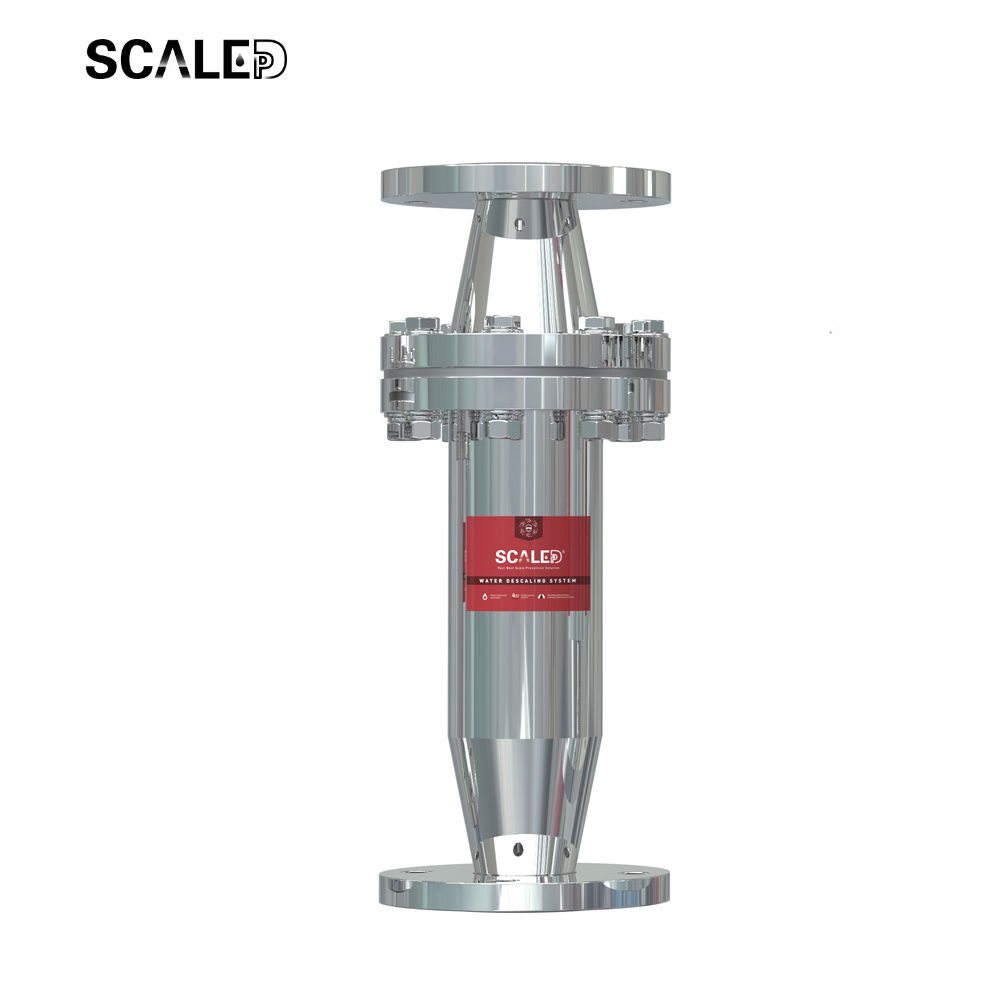
ScaleDp DPSE SCALEDP ID003 installed for Tubular Heat Exchanger water treatment, supporting descaling, continuous scale inhibition, anti-corrosion protection, and rust-removal/rust-reduction in the water system.
Suitable conditions
Hard-water scaling, existing or recurring mineral deposits, corrosion/rust risk in the water path, measurable performance drift, and an installation point matching DN50 / 10 m3/h recommended flow.
Why this solution
DPSE SCALEDP ID003 matches the catalog DN/flow range and supports descaling, scale inhibition, anti-corrosion protection, and rust reduction without routine chemical consumables.
Unsuitable conditions
If oil, biological fouling, suspended solids, strict TDS targets, hygiene validation, or process chemistry are also present, combine ScaleDp with the matching filtration, cleaning, sanitation, or chemistry-control step for a complete water-system program.
Limitations
For severe blockage or complex water chemistry, an initial clean baseline and supporting filtration or chemistry checks can speed recovery and make ScaleDp descaling, scale inhibition, anti-corrosion, and rust-reduction performance easier to verify.
Share pipe size, flow rate, water report, rust/scale photos, and site layout so we can confirm the ID003 selection and installation position.
Contact us for model selectionSuggested installation position
Install on hot water loop makeup or utility circulation before the tubular exchanger, outside product-contact piping.
Upload a photo of your pipe layout. We can mark the suggested installation position.

Show flow direction, pump, valves, bypass, filters, and the ScaleDp ID003 position before the target equipment.
DPSE SCALEDP ID003 Industrial Water Descaler
Available series and model options
DPSE SCALEDP Industrial Series Parameters
Compare ID001 to ID008 by nominal diameter, flange connection, flow range, pressure, and temperature before final model confirmation.
| Model | Nominal Diameter | Connection | Recommended Flow | Flow Range | Max Pressure | Temp |
|---|---|---|---|---|---|---|
| ID001 | DN32 | Flange | 4 m3/h | 1.4-8 m3/h | 1.6 MPa | 5-280 deg C |
| ID002 | DN40 | Flange | 7 m3/h | 2-12 m3/h | 1.6 MPa | 5-280 deg C |
| ID003 | DN50 | Flange | 10 m3/h | 3.5-20 m3/h | 1.6 MPa | 5-280 deg C |
| ID004 | DN65 | Flange | 18 m3/h | 6-35 m3/h | 1.6 MPa | 5-280 deg C |
| ID005 | DN80 | Flange | 27 m3/h | 9-50 m3/h | 1.6 MPa | 5-280 deg C |
| ID006 | DN100 | Flange | 42 m3/h | 14-80 m3/h | 1.6 MPa | 5-280 deg C |
| ID007 | DN125 | Flange | 66 m3/h | 22-120 m3/h | 1.6 MPa | 5-280 deg C |
| ID008 | DN150 | Flange | 95 m3/h | 32-180 m3/h | 1.6 MPa | 5-280 deg C |
Final model should be confirmed by pipe size, actual flow rate, pressure, temperature, water quality, and installation layout.
Information needed before final model selection
Required parameters
Pipe size, flow rate, pressure, temperature, water hardness, alkalinity, TDS, corrosion/rust observations, connection type, and site photos for ID003 confirmation.
Water report fields
Hardness, alkalinity, TDS, pH, chloride, iron, manganese, silica, sulfate, conductivity, and any visible rust or corrosion notes.
Scale thickness or visible deposits, rust/corrosion observations, pressure drop, flow rate, outlet temperature, cleaning interval, downtime, and water-quality trend.
Baseline problem and monitoring guidance
Before problem
Heat transfer performance drifted and extended cleaning was needed more often during high-production periods.
After-installation observation
After installing ScaleDp ID003, track descaling progress, new scale prevention, corrosion/rust reduction, pressure, flow, temperature, and cleaning interval against the pre-install baseline.
Data type: engineering_experience | Urgency level: high
Framed as monitoring guidance, not a verified performance claim. Replace with a real anonymized case when measured customer data is available.
Maintenance, inspection and safety notes
Follow dairy plant hygiene zoning, hot-water isolation, CIP chemical safety, pressure release, and lockout procedures.
Other treatment methods to compare
Validated CIP program optimization
Choose CIP optimization first when product-side milkstone, protein, or fat fouling is the dominant issue.
Water softening for utility makeup
Choose softening when utility water hardness must be reduced to a defined specification.
Share water hardness, flow rate, pipe size, and site photos.
Our team can help check the suitable installation position and confirm whether additional pre-filtration, bypass space, or pre-cleaning is needed.
Common questions about Milkstone and Water Scale Prevention
Can ScaleDp remove existing scale and prevent new scale?
Yes. ScaleDp is positioned for descaling and ongoing scale inhibition. For heavily blocked equipment, establishing a clean baseline can speed recovery and make the improvement easier to measure.
Does ScaleDp also help with corrosion and rust?
Yes. The product positioning includes anti-corrosion protection plus rust-removal and rust-reduction support in water systems. Track chloride, pH, iron, oxygen exposure, and visible rust trend for verification.
How is the correct model selected?
Select by nominal diameter, flow, pressure, temperature, connection, and site layout. This page maps the case to DPSE SCALEDP ID003 from the product catalog.