
Hard water treatment should solve the source of repeated limescale, not only clean the white deposits that appear afterward. In a home, the same mineral-rich water flows through the main pipe, water heater, bathrooms, kitchen and appliances. Therefore, treating one faucet or descaling one kettle cannot protect the complete plumbing system.
ScaleDp offers a point-of-entry approach to household scale control. This hard water treatment is installed on the incoming main line, so it can reduce hard mineral adhesion before water reaches downstream pipes, heaters, showers and appliances. It works without salt, chemical dosing, external electricity or regeneration wastewater.
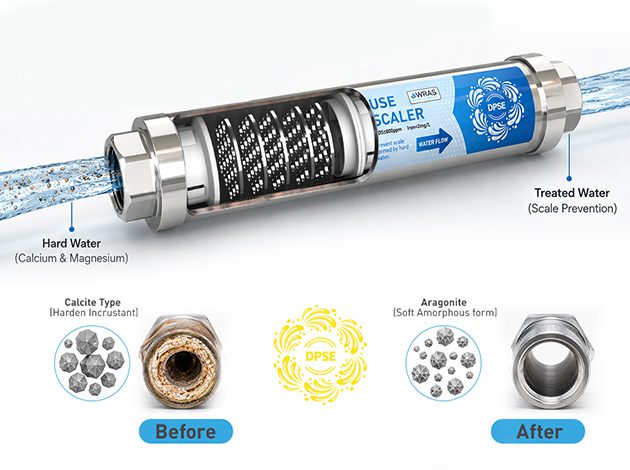
However, ScaleDp is not an ion-exchange softener. It does not remove calcium and magnesium or make a hardness test read zero. Its role is to control how hardness minerals crystallize and attach. This distinction is essential when comparing hard water solutions for home use.
Why Hard Water Becomes Limescale Inside a Home
Calcium and magnesium can remain dissolved in cool, moving water. The balance changes when the water is heated, evaporates or repeatedly dries on a surface. Calcium carbonate can then leave the water and form a solid mineral deposit.
Several household conditions accelerate this process:
- High temperature: Water heaters, boilers, coffee machines and dishwasher heaters create favorable conditions for precipitation.
- Evaporation: Water droplets leave minerals on shower glass, faucets, sinks, tiles and dishes.
- Narrow water passages: Aerators, showerhead holes, valves and tankless heat exchangers can lose flow as deposits grow.
- Standing water: Low-flow branches and equipment chambers allow minerals and particles to settle.
- Existing rough deposits: Old scale creates more surface area on which new crystals can attach.
This explains why limescale keeps returning after cleaning. Acid removes yesterday’s deposit, but untreated hard water supplies tomorrow’s minerals. Source-level hard water treatment is needed to interrupt that repeating cycle.
Where Hard Water Causes the Most Household Problems
Water heaters
Water heaters face one of the highest scale risks because they combine heat, mineral-rich water and long operating hours. Deposits can coat electric elements, tank surfaces or tankless heat exchangers. Scale then acts as thermal resistance between the heat source and the water.
Warning signs may include slower heating, unusual noise, unstable hot-water delivery, rising service frequency and reduced flow through a tankless unit. These symptoms can also have other causes, so technicians should inspect the equipment before assuming scale is responsible.


Pipes, valves and small openings
Scale can reduce the effective opening inside pipes and interfere with valves. Showerheads and faucet aerators often show the problem first because their outlets are small. Users may notice uneven spray, weak flow or frequent blockage.


Bathrooms and visible surfaces
Shower glass, dark tiles and metal fittings reveal mineral residue quickly. Repeated cleaning removes the visible layer, but it does not change the incoming water. As a result, labor and cleaning-product use continue.
Dishwashers, washing machines and kitchen equipment
Heating elements, spray arms, valves and internal channels can collect scale. Cloudy glassware, white residue and inconsistent equipment performance may follow. Coffee machines, steam equipment and kettles face an especially high risk because they heat small volumes repeatedly.


| Household location | Typical hard-water effect | Why source treatment matters |
|---|---|---|
| Water heater | Scale on heating and heat-transfer surfaces | Incoming water is treated before every heating cycle |
| Pipes and valves | Restriction and moving-part interference | Hidden plumbing receives continuous protection |
| Showers and faucets | Blocked outlets and visible residue | Every bathroom receives treated water |
| Dishwasher | Mineral film, scale and blocked spray openings | Protection begins before water enters the appliance |
| Coffee and kitchen equipment | Scale in heaters and narrow channels | Repeated heating starts with scale-controlled water |
Why Cleaning Alone Is Not a Hard Water Solution
Cleaning and treatment perform different jobs. Vinegar, citric acid and manufacturer-approved descaling chemicals dissolve deposits that already exist. They can restore a surface or appliance when used correctly. Yet they do not alter the next volume of hard water entering the property.
A cleaning-only strategy creates a cycle:
- Hard water enters the home.
- Heat and evaporation produce scale.
- The user cleans a fixture or services an appliance.
- The same untreated water returns.
- New scale forms again.
Corrective descaling may still be required when deposits are thick or water flow is already restricted. After that work, continuous point-of-entry hard water treatment can reduce the rate of repeated hard-scale buildup.
Comparing Common Hard Water Solutions
There is no single technology for every water-quality objective. The right option depends on whether the customer wants true soft water, scale control, drinking-water purification or protection for one appliance. Effective hard water solutions begin by defining that outcome.
| Solution | Main function | Key advantages | Main limitations |
|---|---|---|---|
| Ion-exchange softener | Removes calcium and magnesium | Produces measurably soft water and improves soap performance | Needs salt, regeneration, drainage and ongoing maintenance |
| Scale-inhibitor cartridge | Doses or uses media to limit deposition | Compact and useful for selected appliances | Media capacity, replacement and approval must be monitored |
| Reverse osmosis | Removes many dissolved substances at one outlet | Useful for drinking and process water | Usually point-of-use; not a practical whole-house scale solution in many homes |
| Periodic acid descaling | Removes existing carbonate deposits | Can restore affected equipment or surfaces | Does not prevent recurrence and may require shutdown |
| ScaleDp physical treatment | Reduces hard-scale adhesion without hardness removal | No salt, chemicals, electricity or regeneration wastewater | Water remains hard; selection depends on chemistry, flow and pipe size |
For homeowners who require true soft water, ion exchange remains the direct answer. For customers who mainly want continuous scale control while retaining minerals, ScaleDp provides a different approach. Clear expectations prevent the two technologies from being compared as if they performed the same task.
How ScaleDp Hard Water Treatment Works
ScaleDp DPSE technology uses an in-line multi-alloy core. As water flows through the device, localized electrochemical activity and a weak microcurrent influence the crystallization behavior of hardness minerals.
Untreated calcium carbonate commonly forms dense calcite-type deposits that attach firmly to metal, plastic, glass and ceramic surfaces. DPSE-treated water is intended to encourage less-adherent crystal behavior. These deposits are more likely to remain dispersed or become easier to rinse away instead of building a hard, compact layer.

The process can be summarized in four steps:
- Incoming hard water passes through the DPSE multi-alloy core.
- Water flow creates the physical activation effect inside the device.
- Scale-forming minerals become less likely to develop strongly adherent crystals.
- Treated water continues to the heater, bathrooms, kitchen and appliances.
ScaleDp does not add salt or a chemical inhibitor. It also does not require an external power supply. Because no ion exchange occurs, calcium and magnesium remain in the water. Therefore, hardness readings before and after the device will remain broadly similar.
How ScaleDp Addresses Existing and New Scale
ScaleDp works primarily as continuous scale control. Its purpose is to reduce the adhesion of new hard scale throughout the treated system. In systems that already contain calcite-type deposits, long-term exposure to treated water may also help some layers loosen or become easier to remove.
This change is gradual. It depends on water chemistry, temperature, flow, deposit composition, pipe material and the thickness of existing scale. A heavily blocked heat exchanger or unsafe water heater should be inspected and cleaned by a qualified technician. No in-line device should be used to delay urgent repair.
For realistic project planning, separate the expected timeline:
- Immediately after installation: Incoming water begins passing through the treatment core.
- During early operation: New mineral adhesion should become easier to manage under suitable conditions.
- Over continued use: Some existing deposits may loosen gradually as treated water circulates.
- Where blockage is severe: Professional cleaning may still be necessary before protection can work effectively.
Why Point-of-Entry Installation Matters
The main advantage of whole-house treatment is coverage. A device installed before the water branches can protect far more than one appliance. Water heaters, hot-water pipes, bathroom fixtures, kitchen equipment and laundry appliances all receive scale-controlled water.
The normal installation sequence is:
Incoming supply → shutoff valve → sediment pre-filter when required → ScaleDp → water heater and household distribution
Well water may need additional pretreatment. High sediment, iron, manganese or turbidity can create deposits that are not simply calcium-carbonate scale. These contaminants should be tested and treated with suitable equipment before final ScaleDp selection.
Selecting the Right ScaleDp Model
The ScaleDp whole-house range includes WD001, WD001-U and WD001-PLUS. All three are designed for residential point-of-entry use with G3/4 or G1 connections, DN20 or DN25 nominal sizes and a published maximum flow of 4 m3/h.
For ScaleDp hard water treatment, the correct model must satisfy both water chemistry and hydraulic demand. A wider chemistry range cannot compensate for insufficient flow capacity.
| Model | Published scale inhibition | Best-fit use | Maximum flow |
|---|---|---|---|
| WD001 | 91% | Standard residential main-line scale control | 4 m3/h |
| WD001-U | 91% | Upgraded in-line residential configuration | 4 m3/h |
| WD001-PLUS | 92% | Higher hardness and more demanding water conditions | 4 m3/h |
The extra percentage point on WD001-PLUS does not mean it has a higher flow rating. Its value is a wider published water-quality range. Review the WD001 and WD001-PLUS comparison when hardness, TDS or iron approaches the standard model’s limits.
Before choosing any model, confirm five values:
- Hardness in mg/L or ppm as CaCO3
- Total dissolved solids in ppm
- Iron in mg/L
- Realistic simultaneous peak flow
- Pipe size and connection standard
Also provide the water source, number of bathrooms, hot-water demand and installation photos. A product should not be selected from pipe diameter alone. Use the ScaleDp PPM and pipe-velocity calculator for preliminary checks.
Practical Benefits for Homeowners
When the water chemistry and hydraulic conditions fit the selected model, ScaleDp can support several household objectives:
- Reduce repeated hard-scale adhesion in pipes and equipment
- Protect water-heater and appliance heat-transfer surfaces
- Lower the frequency of blocked showerheads and faucet aerators
- Make new mineral residue easier to manage on visible surfaces
- Avoid salt handling, brine discharge and regeneration cycles
- Provide whole-home coverage from one main-line installation
Users may still see light mineral spotting after droplets evaporate because the device retains calcium and magnesium. The realistic goal is less hard, strongly bonded scale, not mineral-free water or permanently spotless glass.
Benefits for Distributors, Installers and OEM Buyers
Residential scale problems create repeated after-sales calls. A customer may report a noisy water heater, blocked showerhead, weak flow or cloudy fixture without recognizing the shared hard-water cause. A well-specified point-of-entry solution can address the common source rather than selling a separate remedy for every outlet.
For B2B buyers, ScaleDp also simplifies routine ownership. The device needs no salt refill, chemical dosing, regeneration schedule or electrical connection for its scale-control function. This can reduce the maintenance gap between what a dealer recommends and what the homeowner actually performs. It also gives dealers a lower-care option within their portfolio of hard water solutions for home projects.
Still, professional selection matters. Dealers should record source-water data, peak flow, pipe dimensions and pretreatment. They should also explain that ScaleDp controls scale rather than removing hardness. Clear communication protects the customer and reduces warranty disputes.
Final Recommendation
The most effective household scale strategy starts before limescale reaches the heater, bathroom or appliance. Cleaning is useful for old deposits, but it cannot change the incoming water. Point-of-entry hard water treatment provides continuous protection across the property.
ScaleDp is one of the practical hard water solutions for customers whose main objective is scale control without salt, chemicals, electricity or hardness removal. Its DPSE technology helps reduce hard mineral adhesion while keeping calcium and magnesium in the water.
Successful treatment still depends on correct sizing. Test hardness, TDS and iron. Then confirm peak flow, pipe size, water source and installation position. This data separates a reliable whole-house solution from a product chosen only by marketing language.


