
Water descaler certification matters when you import equipment, specify a project, or build a dealer product range. However, a folder of certificates does not answer every compliance question. You need to know which model each document covers, what it demonstrates, and whether it fits your destination market.
This guide explains WRAS approval, CE marking, and SGS test reports using ScaleDp’s available documents. More importantly, it shows how to turn those files into a practical purchasing checklist. None of these documents replaces the others.
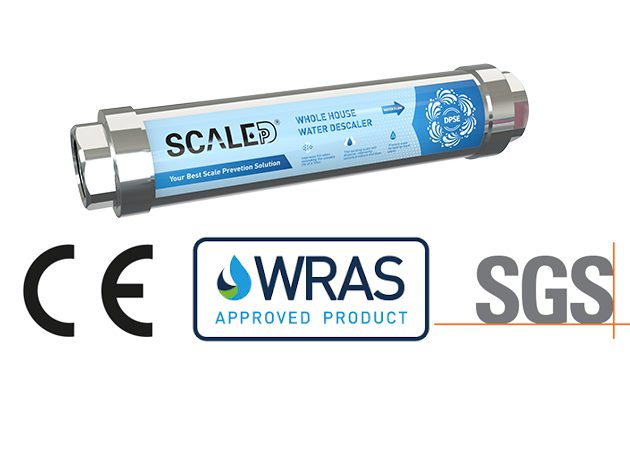
Water Descaler Certification: Three Different Evidence Types
First, separate regulatory conformity, water-fitting approval, and measured performance. A useful document answers a specific question; a familiar logo alone does not.
| Document | Main purpose | What not to assume |
|---|---|---|
| WRAS product approval | Evidence for the listed water fittings, subject to approval and installation conditions | Every model or installation has approval |
| CE conformity documents | Evidence supporting applicable EU product-law obligations | One voluntary certificate proves all EU compliance |
| SGS test report | Results for submitted samples under stated test conditions | The result guarantees performance in every building |
WRAS Approval: Check the Exact Models
For UK projects, applicable Water Fittings Regulations and Scottish Byelaws govern suitability and installation. WRAS is an approval route, not the only legally acceptable form of evidence. Therefore, review the intended installation as well as the product. See WRAS’s official approval guidance.
The ScaleDp WRAS product approval certificate (PDF) lists WDM001 and WD001 water conditioners. It identifies Ningbo Zuanbang Technology Co., Ltd. as the approval holder and gives approval number 240902711. Its stated approval period runs from September 2024 to September 2029.
However, the certificate itself requires confirmation of current approval status. Search the official WRAS Approvals Directory before ordering. Then match the listed model and installation conditions to your specification. Do not extend this approval to unrelated ScaleDp models.
Also, material approval and complete-product approval differ. An approved seal does not approve the entire assembly. Likewise, private-label buyers should check the WRAS rules on model coverage and rebranding. A new brand name does not automatically inherit approval.
CE Marking: Classify the Product First
Next, establish which EU legislation applies to the actual product. According to the EU’s official CE-marking guidance, only products covered by relevant CE legislation may carry the mark. There is no universal authority that issues a CE certificate for every product.
Design matters. For example, electrical controls, radio functions, and pressure characteristics can change the assessment. A passive, flow-driven device does not automatically fall under electrical-equipment rules. Consequently, buyers should request a product-specific applicability review rather than assume every descaler needs identical documents.
The ScaleDp CE/RoHS-related conformity document (PDF) is certificate HA0124NB051564SPC, dated May 29, 2024. It names WD001 and additional listed models. Its stated assessment concerns RoHS Directive 2011/65/EU and amendment (EU) 2015/863.
However, this sample-based document is not a signed EU Declaration of Conformity covering every applicable law. Where CE legislation applies, obtain the declaration, supporting technical file, and relevant assessment evidence. In addition, do not treat a RoHS-related certificate as drinking-water hygiene approval or proof of scale inhibition.
Drinking-Water Materials: Plan for the EU Transition
Water-contact requirements need a separate review. Under Commission Delegated Regulation (EU) 2024/370, the new conformity-assessment framework applies from December 31, 2026. However, a conditional transition applies to qualifying products with national hygiene certificates still valid on that date, until December 31, 2032.
Therefore, do not assume every existing certificate qualifies for that transition. Ask your importer or compliance adviser to assess wetted materials, the complete product, and the applicable route. A material’s listing alone does not settle complete-product compliance.
SGS Reports: Read the Method Before the Percentage
SGS provides testing, inspection, and certification services. Nevertheless, the particular ScaleDp SGS scale-inhibition test report (PDF) is a test report, not a general market-access approval.
Report NBF24-0001142-03, dated March 19, 2024, records a result of 87.26% at 15 L/min under a client-specified method. The procedure uses inlet and outlet samples, boiling, cooling, filtration, and hardness measurements. Thus, this percentage is not a direct measurement of old scale removed from an operating pipeline.
Although the filename refers to WD001, the report body names the sample as a whole-home water descaler without that model code. Before procurement, request traceability between the tested sample and your supplied configuration. Also, review the report’s stated use limitations within mainland China with SGS before commercial reuse.
For project performance, ask a separate question: will the equipment reduce attached deposits under your water chemistry, flow, and heating conditions? Laboratory evidence helps evaluate that question, but it does not replace a controlled site trial.
Your Water Descaler Certification Checklist
Before placing an order, use this water descaler certification checklist to close the gaps between paperwork and the delivered product:
- Define the destination and use. Identify drinking-water contact, building type, and the importer’s requirements.
- Confirm the design. Record pressure, temperature, wetted materials, and any electrical or wireless functions.
- Match identities. Reconcile model codes, manufacturer names, branding, and the tested configuration.
- Collect complete documents. Obtain all report pages, approval conditions, and declarations where applicable.
- Check current status. Verify directory entries, expiry dates, and changes since testing.
- Review delivery information. Check required labels, traceability, destination-language instructions, and installation limits.
- Separate performance acceptance. Agree on baseline measurements, an untreated comparison, and site acceptance criteria.
Finally, agree who will review updates after a material, supplier, or design change. Otherwise, yesterday’s water descaler certification pack may no longer describe tomorrow’s shipment.
Water Descaler Certification Questions
Does WRAS prove a scale-inhibition percentage?
No. Review its stated water-fitting approval scope. For performance, use relevant test evidence and project-specific measurements instead.
Can these three files cover every country?
No. In contrast, each destination can impose different product and installation requirements. Ask the local importer to confirm the required documentation before shipment.
Request a Model-Specific Documentation Pack
ScaleDp helps dealers and engineering buyers evaluate documents alongside product selection. Start with the whole-house water descaler range and DPSE technology overview. Then request partner documentation and project support for your exact model and market. Share water quality, peak flow, operating pressure, and intended use so the review addresses your project.
Document review updated October 21, 2026. This guide provides procurement information, not legal advice. Obtain a qualified assessment for product classification, market access, and installation compliance.



