
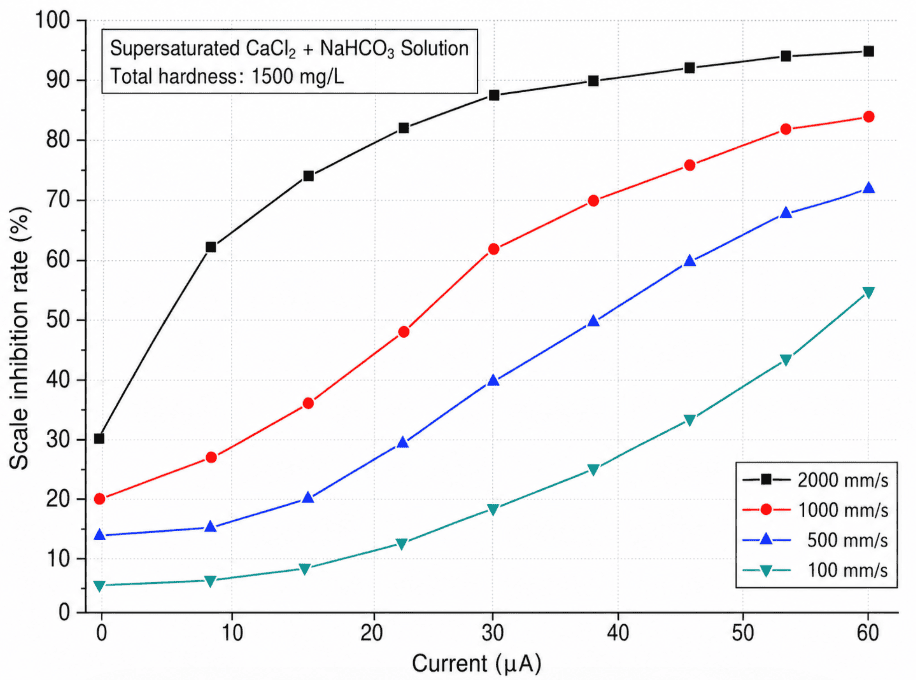
Water velocity is an important operating condition for a physical water descaler.
Unlike a filter, a physical descaler does not capture calcium and magnesium. Unlike a conventional water softener, it does not remove hardness minerals through ion exchange.
Instead, ScaleDp uses Dynamic Physical Scale Elimination (DPSE) to influence the way scale-forming minerals behave while water passes through the treatment core.
Because the treatment happens while the water is moving, how fast the water travels through the device can directly affect the operating condition of the system.
The key point is simple:
Water should move through a physical descaler within its intended operating range. Faster is not always better, and slower is not always better.
What Happens Inside a ScaleDp Physical Water Descaler?
Hard water contains dissolved calcium and magnesium.
When water is heated or becomes more concentrated, calcium carbonate can precipitate and gradually form hard deposits on:
- water heaters;
- heating elements;
- pipes;
- valves;
- faucets;
- heat exchangers.
ScaleDp does not remove calcium and magnesium from the water.
Instead, flowing water interacts with the internal multi-alloy DPSE core. According to the DPSE technical principle, this interaction creates weak micro-electronic activity that influences mineral nucleation and crystallization.
The goal is to make calcium-carbonate particles less likely to develop into dense, strongly bonded scale on water-contact surfaces.
The hardness minerals remain in the water, but their scale-forming behavior is influenced.
Because water must move through the DPSE core for this interaction to occur, water velocity becomes an important part of the operating condition.
Why Water Velocity Matters
Water velocity describes how fast water travels through the treatment section.
The treatment core has a fixed physical length.
This means every portion of water spends a limited amount of time inside the active treatment zone.
If water velocity changes, the time that water remains in contact with the treatment area also changes.
This is why physical scale control does not follow a simple rule such as:
“More flow means better performance.”
Instead, the system should operate within the velocity conditions for which the device was designed and tested.
What Happens If Water Moves Too Fast?
When water moves very quickly through the treatment section, its contact time with the DPSE core becomes shorter.
In simple terms:
higher velocity = shorter treatment time.
If velocity becomes excessively high, water may pass through the device outside the intended operating condition.
This does not mean that every short flow peak causes the system to stop working.
Residential plumbing naturally experiences temporary increases in water demand.
The more important issue is whether the system operates at excessive velocity frequently or continuously.
For example, sudden high-demand conditions may occur when:
- several showers are used at the same time;
- multiple faucets are opened;
- a booster pump creates high flow;
- commercial equipment suddenly demands a large volume of water.
If these conditions repeatedly push the system outside its intended range, scale-control performance may become less consistent.
What Happens If Water Moves Too Slowly?
Very low water velocity creates a different operating condition.
When little or no water is moving, no new water is passing through the DPSE core.
That means the treatment process is not being continuously applied to fresh incoming water.
This does not mean intermittent household use is a problem.
Homes naturally stop and start water use throughout the day.
However, systems with very long periods of stagnation may behave differently from systems with regular water turnover.
Examples include:
- large hot-water storage tanks;
- rarely used branches;
- seasonal properties;
- equipment with long periods between water use.
For these systems, installers should consider not only the descaler itself but also how frequently treated water is replaced inside the protected equipment.
Stable Water Flow Helps Create More Consistent Treatment
A real household never operates at one perfectly constant velocity.
Flow starts when someone opens a faucet and stops when the faucet closes.
During busy periods, water velocity increases.
During quiet periods, it falls back to zero.
This is normal.
The objective is therefore not to create perfectly constant flow.
The objective is to avoid operating conditions where water repeatedly moves far outside the product’s intended range.
A stable and predictable flow pattern helps ensure that fresh incoming water consistently passes through the DPSE treatment core before reaching downstream equipment.
This is particularly important for:
- water heaters;
- boilers;
- heat exchangers;
- hot-water systems;
- other scale-sensitive equipment.
Water Velocity and Heating Equipment
Heating equipment deserves special attention because temperature strongly affects calcium-carbonate scale formation.
In a tankless water heater, treated water flows through the ScaleDp unit and then moves relatively quickly into the heat exchanger.
The water is continuously replaced while the heater operates.
In a storage water heater, the situation is different.
Treated water enters the tank and may remain hot for many hours.
This means the system contains both a flowing treatment stage and a later storage stage.
For this reason, physical scale control should not be judged only by what happens inside the descaler itself.
The actual water-use pattern of the heating system also matters.
Existing heavy scale may still require professional cleaning before long-term scale control can provide the best operating conditions.
A physical descaler is designed for ongoing scale management, not instant removal of severe blockage.
Does Turbulent Flow Improve Descaling?
Most active household water lines operate under turbulent rather than perfectly laminar flow conditions.
Turbulence creates mixing across the water stream, which can help distribute the interaction between the flowing water and the treatment section.
However, turbulence by itself should not be treated as proof of descaling performance.
Actual scale behavior also depends on:
- water hardness;
- alkalinity;
- temperature;
- TDS;
- operating time;
- existing scale conditions.
For this reason, users should not intentionally create excessive turbulence by adding unnecessary restrictions or fittings.
The correct approach is simply to follow the ScaleDp installation requirements and keep water moving through the unit in the intended direction.
How Should Flow-Related Performance Be Evaluated?
A physical water descaler should not be evaluated by checking whether water hardness drops.
Calcium and magnesium remain in the water, so a standard hardness test should stay broadly similar before and after treatment.
Instead, performance should be evaluated over time.
Useful indicators include:
- whether hard scale accumulates more slowly;
- whether deposits become easier to clean;
- whether heating surfaces remain cleaner;
- whether showerheads and faucets require less frequent descaling;
- whether heat-transfer performance remains more stable;
- whether scale-related maintenance intervals become longer.
Residential systems may require several weeks or months before a meaningful trend becomes visible.
The important question is not:
“Did the hardness number change?”
It is:
“How is scale behaving inside the system over time?”
The Bottom Line
Water velocity is not just a plumbing detail.
For a physical water descaler, it is part of the operating condition that determines how water passes through the treatment core.
If water moves too quickly, treatment time becomes shorter.
If water remains stagnant for long periods, fresh water is not continuously passing through the device.
The best operating condition is therefore not the highest possible velocity.
It is water moving through the ScaleDp DPSE core within the intended operating range and continuing toward the equipment that requires scale protection.
This is why water velocity should always be considered when evaluating a physical water descaler.
With the correct operating conditions, ScaleDp can provide continuous physical scale control while keeping calcium and magnesium in the water—without salt regeneration, chemical dosing, or hardness removal.



