
Your local water report might list hardness as 200 ppm, while a dishwasher manual uses °dH and a softener supplier quotes GPG. Are these different measurements? Usually, they are simply different water hardness units. The key is to confirm what the number represents before converting it.
First, Find the Right Hardness Result
Look for total hardness, expressed as mg/L as CaCO3. Hardness mainly reflects dissolved calcium and magnesium. “As CaCO3” is a common reporting basis; it does not mean the water already contains that quantity of solid limescale.
Also check the supply zone, sampling period, and whether the figure is an average or a range. Your supplier may publish hardness separately from its main quality report. If the value is missing, ask for total hardness for your address. A local test is useful for private wells or water that passes through on-site treatment.
Water Hardness Units: A Quick Conversion Table
These conversions use calcium-carbonate equivalents throughout:
| Unit | Meaning | Equivalent hardness |
|---|---|---|
| ppm | Parts per million | Approximately 1 mg/L as CaCO3 in dilute drinking water |
| GPG | Grains per US gallon | 1 GPG ≈ 17.1 mg/L as CaCO3 |
| °dH | German degrees of hardness | 1 °dH ≈ 17.85 mg/L as CaCO3 |
| °fH | French degrees of hardness | 1 °fH = 10 mg/L as CaCO3 |
The Maryland Geological Survey gives the US-GPG conversion; Southern Water’s guidance provides French and German conversion factors. Note that °fH is a hardness unit, not degrees Fahrenheit.
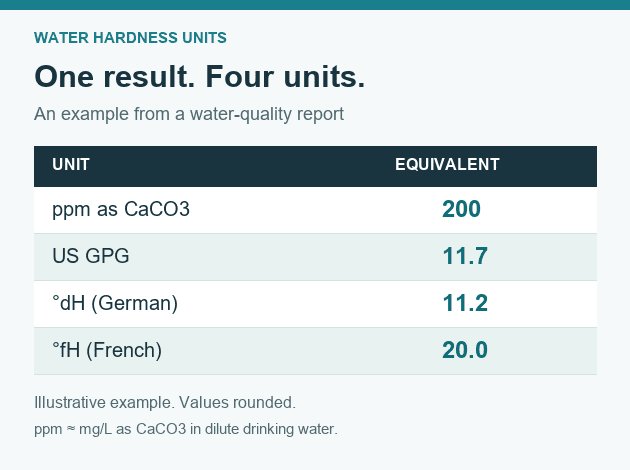
Example: 200 mg/L as CaCO3 is approximately 200 ppm = 11.7 GPG = 11.2 °dH = 20 °fH. Divide the mg/L result by 17.1, 17.85, or 10 respectively. These are rounded equivalents of the same hardness, not four different water qualities.
Does That Number Mean Your Water Is Hard?
The USGS classification uses 0–60 mg/L as soft, 61–120 as moderately hard, 121–180 as hard, and above 180 as very hard. However, classification bands differ between authorities. Therefore, compare the actual concentration and unit, not just the label “hard.” These categories describe hardness, not whether water passes every drinking-water safety test.
Common Mistakes With Water Hardness Units
- Using a TDS meter as a hardness test: TDS covers dissolved substances beyond calcium and magnesium. Therefore, a TDS reading in ppm is not a direct hardness result.
- Confusing calcium with total hardness: 80 mg/L of calcium is not 80 mg/L of total hardness as CaCO3. When calcium and magnesium dominate, Health Canada explains the approximate calculation: hardness = 2.5 × calcium + 4.1 × magnesium, with both minerals in mg/L.
- Treating alkalinity as hardness: both may be reported “as CaCO3,” but they measure different properties. Likewise, calcium hardness alone excludes magnesium hardness.
Use the Result to Address the Actual Problem
A hardness result helps assess scale potential, but temperature, alkalinity, pH, and operating conditions also matter. In addition, recurring deposits in kettles, water heaters, and shower outlets provide useful practical context.
If you need lower calcium and magnesium concentrations, consider suitable softening. If the main concern is attached limescale, ScaleDp whole-house scale control is designed to target mineral deposition without removing hardness minerals. Consequently, a lower hardness reading is not its performance measure; assess actual deposit behavior and maintenance under comparable conditions.
Bottom line: confirm the parameter, reporting basis, and unit first. Then choose treatment around the problem you actually need to solve.



