
Many companies encounter a similar situation during product development. In order to meet the needs of different users, working conditions, and water quality requirements, manufacturers often launch two products that look almost identical. From the outside, they may have the same housing, connection ports, and installation method, but the real differences are often hidden in the internal configuration and core performance parameters.
For example, although different models may look similar, they can vary significantly in applicable water quality, treatment capacity, application scenarios, and internal configuration. These invisible internal differences determine the operating conditions the equipment can adapt to and the actual treatment performance. Some models are more suitable for small-flow systems, commercial applications, or local water-use points, while others are better suited for large-flow systems, industrial production lines, or water systems with more complex water quality.
Because the two products look almost the same, many customers may wonder: Why do these two products look identical but have different prices? What are the real differences between them? Which one is more suitable for my project?This article will introduce the differences between ScaleDp’s two popular whole-house water descaler models, WD001 and WD001-PLUS, and explain how to choose the right one.
1.What Is the Difference Between WD001 and Its Upgraded Version WD001-PLUS?
1.1 Different DPSE Chip Configurations
The core difference between WD001 and WD001-PLUS lies in the material configuration of the internal DPSE chip.
WD001 uses a DPSE chip composed of 8 types of alloys. It is the standard configuration for whole-house water descalers and is suitable for most daily household water-use scenarios. For regular municipal water and ordinary hard water conditions, WD001 can help reduce scale adhesion on pipes, water heaters, faucets, showerheads, and other water-related equipment. It is suitable for standard whole-house water systems.
WD001-PLUS uses an upgraded DPSE chip composed of 9 types of alloys, with a richer alloy material combination. When water flows through the device, it can produce a more sufficient physical effect, making it more suitable for high-hardness water, complex water quality, or household water systems with more serious scale problems.
Simply put, WD001 is more suitable for regular whole-house scale control needs, while WD001-PLUS is the upgraded version, designed for more complex water quality, higher hardness levels, or applications with higher requirements for scale control performance.
Under standard test conditions, WD001 shows approximately 91% scale adhesion inhibition performance, while WD001-PLUS can achieve approximately 92% scale inhibition performance. Although the difference in data may seem small, the main advantage of WD001-PLUS lies in its stronger adaptability to complex water quality and more stable long-term protection.

1.2 Differences in Water Quality Adaptability
When choosing a whole-house water descaler, water quality compatibility is a key factor in addition to appearance and installation method. Both ScaleDp WD001 and WD001-PLUS are designed for residential whole-house water systems. However, WD001-PLUS offers stronger water quality adaptability, making it more suitable for complex water conditions such as high hardness, high TDS, or higher iron content.
Water Quality Range of WD001
The applicable water quality conditions for WD001 are:
Hardness ≤450 mg/L
pH 3–10
TDS ≤800 ppm
Iron <2 mg/L
WD001 is suitable for most standard residential whole-house water applications. It can cover common municipal tap water, some groundwater conditions, and general hard water environments.
A hardness level of ≤450 mg/L can already meet the needs of most household hard water conditions. TDS ≤800 ppm is suitable for typical residential water quality, while Iron <2 mg/L allows the device to adapt to water with a certain level of iron content.
If the local water contains high hardness, high TDS, high iron, or a large amount of sediment, it is recommended to use WD001 together with a pre-filter, iron removal system, or other water filtration equipment to achieve more stable performance.
Water Quality Range of WD001-PLUS
The applicable water quality conditions for WD001-PLUS are:
Hardness ≤800 mg/L
pH 3–10
TDS ≤2000 ppm
Iron <5 mg/L
Compared with WD001, WD001-PLUS has a significantly wider adaptability range in terms of hardness, TDS, and iron content. It is more suitable for whole-house water systems in areas with severe scale problems, complex water quality, or households using groundwater or well water.
WD001-PLUS can handle higher water hardness, making it suitable for regions where water heaters, pipes, faucets, and water-related appliances are more prone to scale buildup. It can also adapt to higher TDS levels and higher iron content, making it more suitable for water environments with high mineral content, yellowish water, rust, or mixed deposits of iron and scale.

2. From a Buyer’s Perspective: How to Choose Between WD001 and WD001-PLUS?
For buyers, choosing between WD001 and WD001-PLUS is not only about appearance and price. The key is to consider the water quality in the target market, customer type, and potential after-sales risks.
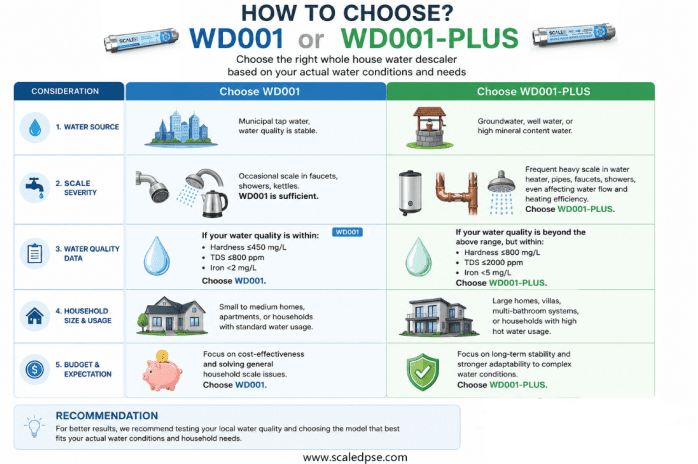
If the target customers mainly use municipal tap water, the water quality is relatively stable, and the scale problem is mild to moderate, such as in standard homes, apartments, and small villas, then WD001 can usually meet the demand. In general, when the water quality falls within Hardness ≤450 mg/L, TDS ≤800 ppm, and Iron <2 mg/L, WD001 is a more economical and practical choice, especially for cost-effective residential markets.
If the target market has high-hardness water, groundwater, well water, high TDS, or higher iron content, and customers often experience obvious scale buildup, yellowish water, rust deposits, or frequent scaling in water heaters, pipes, and showerheads, then WD001-PLUS is recommended. When the water quality falls within Hardness ≤800 mg/L, TDS ≤2000 ppm, and Iron <5 mg/L, WD001-PLUS offers stronger water quality adaptability and is more suitable for complex water conditions, large homes, villas, and higher-demand projects.
In simple terms, WD001 is suitable for standard residential markets, with the advantage of being economical and practical. WD001-PLUS is better suited for complex water conditions and higher-end projects, offering a wider adaptability range and lower after-sales risk. Buyers can choose the right model based on local water source type, water quality test data, scale severity, and target customer budget.
3. Is a Pre-Filter Required?
It is important to note that ScaleDp WD001 and WD001-PLUS are physical water descaling devices. Their main function is to change the formation and adhesion behavior of scale, helping reduce scale deposits on pipes, water heaters, and water-related equipment.
If the water contains a large amount of sediment, suspended solids, rust particles, or other impurities, it is recommended to install a pre-filter before the device. This allows large particles to be removed first, while the ScaleDp device performs physical scale control afterward, helping improve the stability of the overall water system.
For well water, groundwater, or water with higher iron content, if the iron level is close to the applicable limit of the product, it is recommended to use an iron removal system or other pre-treatment equipment based on the actual water quality report to achieve better long-term performance.
4. Conclusion: WD001 and WD001-PLUS Differ Not Only in Appearance, but Also in Application Capability
WD001 and WD001-PLUS may look similar from the outside, but the real differences lie in the internal DPSE chip configuration, water quality adaptability, and performance under more complex water conditions.
If your home uses standard municipal tap water, the water quality is stable, and the scale problem is at a normal level, WD001 is a cost-effective whole-house water descaler.
If your water has higher hardness, higher TDS, higher iron content, or if you often use groundwater or well water where scale and rust problems are more obvious, WD001-PLUS is a more suitable upgraded option.
When selecting a model, it is recommended to refer to the water quality test report first, including key data such as hardness, pH, TDS, and iron content. If you are not sure which model is more suitable for your project, you can send your water quality report, pipe size, application scenario, and installation position to the ScaleDp team. We will recommend a more suitable whole-house water descaling solution based on your actual operating conditions.


