
Whole House Water Descaler for Limescale Protection
Reduce hard water scale buildup in your pipes, water heater, faucets, showers and appliances with ScaleDp, a salt-free, chemical-free and power-free whole house water descaler installed on the main incoming water line.

Whole House Water Descalers
Select the Right Model
Compare connection size, scale inhibition rate and recommended flow for residential POE scale-control projects.
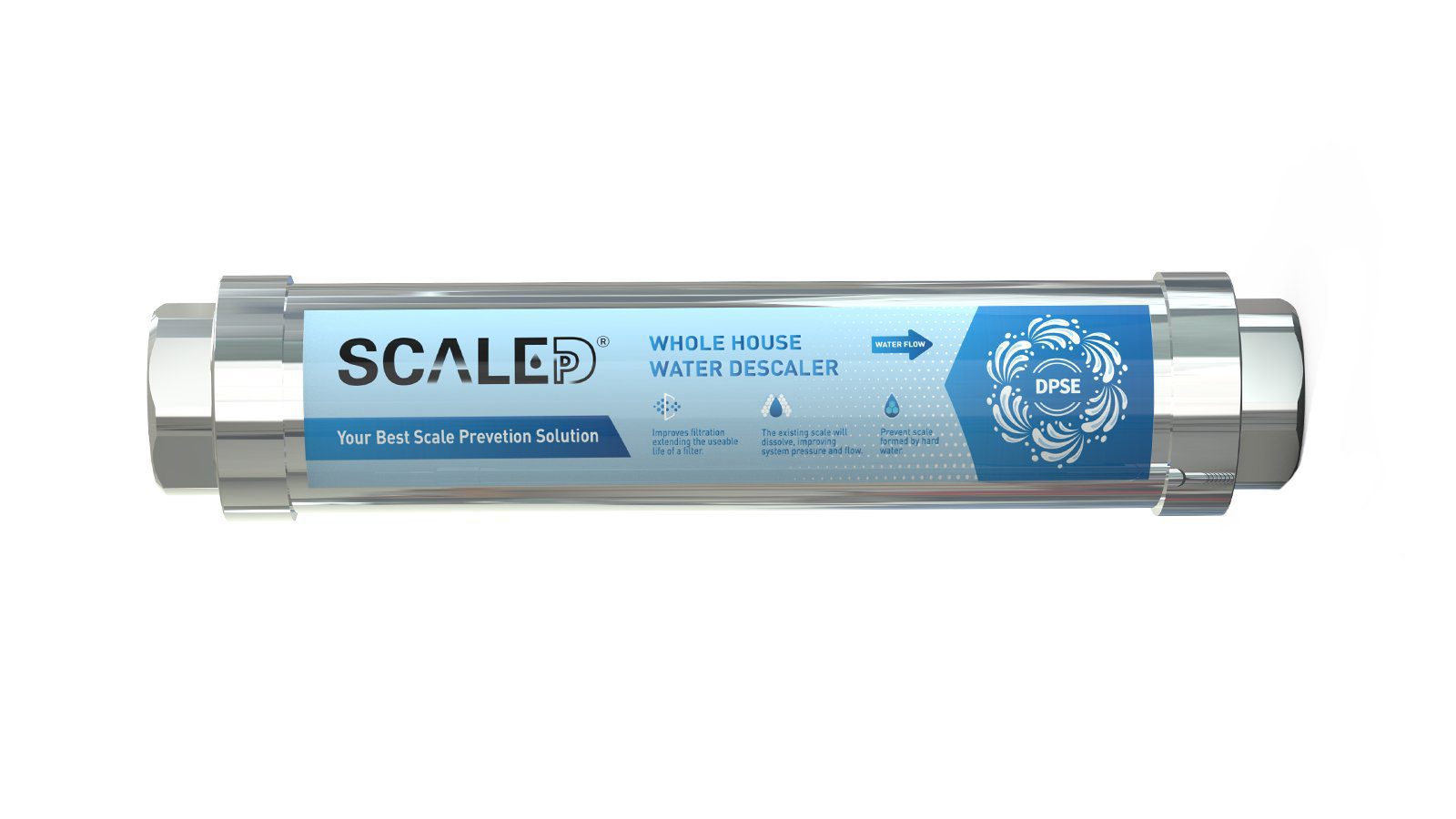
WD001
Standard whole-house scale control for residential main water lines.
- ConnectionG3/4", G1"
- Scale Inhibition91%
- Max. Flow4m³/h
- Nominal SizeDN20, DN25
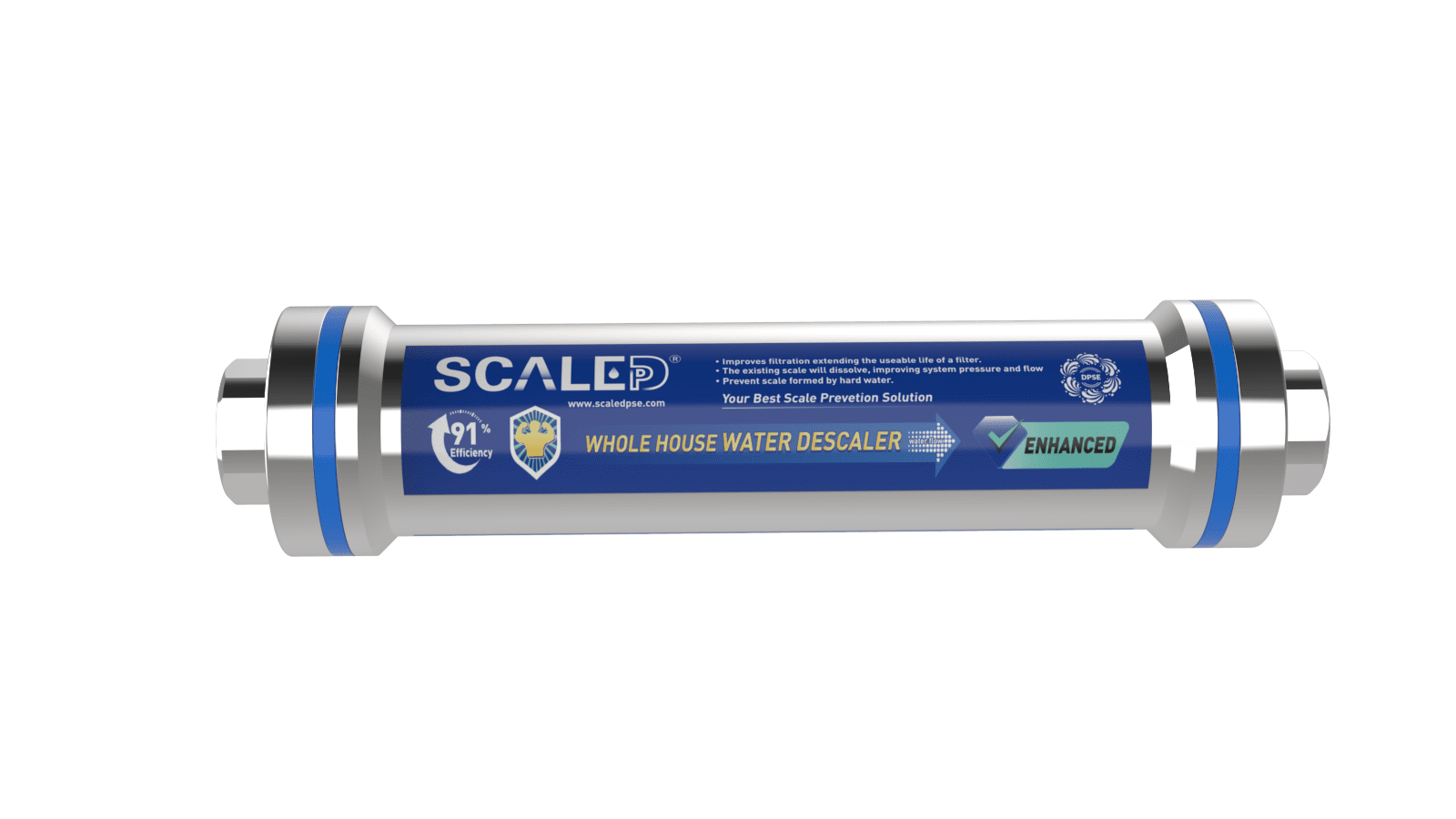
WD001-U
Upgraded in-line model for continuous whole-house scale protection.
- ConnectionG3/4", G1"
- Scale Inhibition91%
- Max. Flow4m³/h
- Nominal SizeDN20, DN25
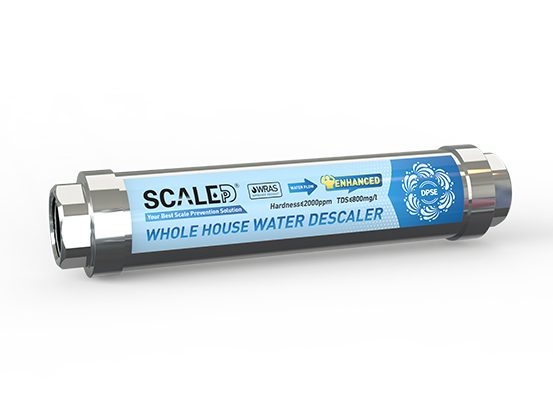
WD001-PLUS
Enhanced model for higher hardness and more demanding water conditions.
- ConnectionG3/4", G1"
- Scale Inhibition92%
- Max. Flow4m³/h
- Nominal SizeDN20, DN25
Key parameters decoded for whole-house project selection.
This section turns the WD001 parameter card into usable engineering information for distributors, installers and project buyers. It focuses on flow, pressure, temperature, connection options, construction and installation planning.

WD001 whole-house in-line water descaler
Designed for residential point-of-entry scale-control installations on the main incoming water line. The unit works without salt, chemical dosing, electricity or regeneration wastewater.
Values below are taken from the manufacturer parameter card. Final sizing should also consider actual peak flow, water analysis, pipe layout and local installation requirements.
What the limits mean on site
- Size the device against simultaneous demand, not only daily water consumption.
- Keep operating pressure and temperature within the stated limits.
- Confirm the selected connection option against the actual pipework before ordering.
- Provide accessible space for inspection and future plumbing work.
Service-life statement
The manufacturer parameter card states a 10-year service life and a maintenance-free design. Actual service conditions and warranty terms should be confirmed for the project and purchase order. This statement does not replace leak checks, upstream filter service or routine plumbing inspection.
WD001 construction and wetted components
A component-level material summary for technical review and submittal preparation.
| Main body | 304 stainless steel |
|---|---|
| Turbulence generator | POM |
| Turbine disc | Alloy |
| Pressure reducer cap | 304 stainless steel |
| Sealing component | Silicone |
| Turbine disc spacer | POM |
Confirm the water, demand and installation conditions before ordering.
A whole-house descaler should be selected from real project data. These checks help prevent undersizing and clarify when pretreatment or a different solution may be required.
Identify municipal or well water, hardness, iron, manganese, sediment and turbidity. Challenging well-water conditions may need pretreatment.
Estimate the highest combined demand from showers, taps and appliances. Peak flow is more important than total daily consumption for device sizing.
Confirm pipe size, connection standard, operating pressure, water temperature, straight-run space, access and any bypass requirement.
A practical sequence for a reliable whole-house installation.
Final installation must follow the applicable plumbing code and the confirmed product instructions for the supplied connection version.
Watch the installation, testing and working principle.
Use these short videos to understand how ScaleDp is installed, how the product is tested and how the technology works. Click any video to open it in a popup player without leaving this page.
Hard water scale is a whole-house problem, not just a faucet problem.
Limescale does not only appear on faucets or shower glass. When hard water flows through the entire plumbing system, calcium and magnesium minerals can form scale deposits on pipe walls, heating surfaces, valves, faucets, showers and water-using appliances.


What it is and where it should be installed.
A whole house water descaler is a main-line scale control device installed on the incoming water pipe. It is designed to reduce the effects of hard water scale throughout the whole property, including the kitchen, bathroom, water heater, laundry area and other water-using fixtures.

How ScaleDp helps reduce new scale and loosen existing scale.
ScaleDp works in two directions: helping reduce new hard scale formation and supporting the gradual loosening of existing calcite-type deposits. Actual results depend on water quality, flow rate, temperature and the condition of the existing scale.
Existing scale starts to loosen
Old hard scale may gradually soften and become easier to wash away as treated water flows through the system.
Deposits become easier to clean
Scale adhesion is reduced, and deposits may become less sticky on surfaces exposed to treated water.
New scale is easier to manage
New deposits tend to be softer and easier to clean compared with hard, sticky calcite scale.

Before Treatment
Before treatment, hard and adherent calcite-type deposits may build up on water-contact surfaces.

During Descaling
During treatment, existing deposits may gradually loosen as treated water continues to flow through the system; the timing varies by water quality and operating conditions.

After Treatment
Under suitable operating conditions, newly formed mineral deposits may be less adhesive and easier to rinse or clean.

From hard calcite scale to easier-to-rinse aragonite deposits.
Scale inhibition starts when water flows through the ScaleDp water descaler. After operation, the DPSE-treated water helps change scale crystal behavior so that hard calcite-type deposits gradually become softer and easier to disperse.
The microscope comparison helps explain why ScaleDp is used for both scale inhibition and descaling support in whole-house hard water systems.
Microscope Comparison of Calcite Crystals After DPSE Treatment
The comparison below shows hardened water samples before and after DPSE treatment under different flow conditions. It helps visualize how scale crystals become less compact and easier to disperse after treatment.

ScaleDp and traditional water softeners treat hard water scale in different ways.
A traditional water softener removes calcium and magnesium through ion exchange and usually requires salt, regeneration and wastewater discharge. ScaleDp does not remove hardness minerals. It uses physical scale inhibition to reduce hard scale adhesion without salt, chemical dosing or regeneration wastewater.
| Item | ScaleDp Whole House Water Descaler | Traditional Water Softener |
|---|---|---|
| Visual comparison |  |  |
| Main purpose | Reduce hard scale adhesion and support descaling | Remove calcium and magnesium |
| Method | DPSE physical scale inhibition | Ion exchange |
| Salt required | No | Yes |
| Wastewater | No regeneration wastewater | Brine wastewater |
| Electricity | No | Often required by control valve |
| Minerals | Retains calcium and magnesium | Removes hardness minerals |
| Maintenance | Low maintenance | Salt refill and regeneration maintenance |
| Best for | Scale control and equipment protection | True soft water |
Real whole house water descaler installation case
See how ScaleDp is installed in a whole house water system to help reduce limescale problems across the property. This case shows how main-line installation can support water heater protection, bathroom scale control and long-term plumbing maintenance.

Documents for product evaluation and scale inhibition reference.
ScaleDp provides certification and testing documents including WRAS, CE and SGS scale inhibition report to support product evaluation and project communication.
WRAS approval No. 240902711 applies to the WDM001 and WD001 water conditioners and is valid from September 2024 to September 2029, subject to confirmation in the current WRAS Approvals Directory. SGS report No. NBF24-0001142-03 records an 87.26% scale-inhibition result for a sample identified as “Whole home water descaler,” tested at 15 L/min using a client method. The report should not be presented as model-specific evidence for WD001, WD001-U or WD001-PLUS unless the applicable report expressly identifies that model. The CE document is provided as a compliance reference; it is not a performance test or evidence of a stated scale-inhibition rate.
Whole house water descaler FAQ.
Does a whole house water descaler remove calcium and magnesium?
No. ScaleDp does not remove calcium and magnesium like a traditional water softener. It helps change how hardness minerals crystallize, reducing their tendency to form hard, sticky limescale on surfaces.
Does ScaleDp soften water?
No. ScaleDp is not a softener. It is a physical water descaler designed for scale inhibition and descaling support.
Can ScaleDp help existing limescale?
ScaleDp can help loosen existing calcite-type scale over time and make deposits easier to wash away. Actual results depend on water quality, flow rate, temperature and the condition of the existing scale.
Does ScaleDp need salt?
No. ScaleDp is salt-free and does not require salt refill or brine regeneration.
Does ScaleDp need electricity?
No. ScaleDp works without electricity. It uses water flow and DPSE multi-alloy technology for physical scale inhibition.
Where should a whole house water descaler be installed?
It is usually installed on the incoming main water line, after sediment pre-filtration and before water goes to the water heater, bathrooms, kitchen and appliances.
Is ScaleDp suitable for well water?
It may be used for well water, but water testing is recommended. High sediment, iron, manganese or turbidity should be handled by proper pre-treatment before installation.
How do I choose the right ScaleDp model?
Model selection should be based on pipe size, water source, hardness, peak flow demand, number of bathrooms, hot water usage and whether the system is residential or light commercial.
Stop limescale before it damages your water system.
Send your pipe size, water source, hardness level, application and estimated quantity. We can help recommend a suitable whole house ScaleDp model.
Suggested inquiry fields: company name, country, business type, pipe size, water source, hardness level, application, estimated quantity and project photos.
