
In fact, limescale can waste energy before equipment stops working. A water heater may still deliver hot water, a boiler may still produce steam and a chiller may remain online. However, the heater runs longer, the burner uses more fuel or the compressor works against higher pressure to maintain the same output.
Therefore, this guide explains why limescale increases energy consumption, the limits of popular percentage claims and the operating data buyers should use to verify the cost.
Why Limescale Increases Energy Consumption
Limescale is a mineral deposit that commonly contains calcium carbonate. Hard water supplies the dissolved calcium and magnesium that make scale possible. According to the U.S. Geological Survey, water above 180 mg/L as CaCO3 is classified as very hard, and heating hard water can form deposits that increase water-heating costs. Local hardness information is available in the ScaleDp Water Hardness Guide.
More specifically, temperature, alkalinity, pH, evaporation, residence time and surface condition determine whether those minerals remain dissolved or deposit on equipment. In evaporative systems, water leaves while minerals remain. Meanwhile, the carbonate balance changes near hot metal in heated equipment. As a result, deposits tend to form exactly where efficient heat transfer matters most.
The energy-loss chain is straightforward:
- Hard water enters the system.
- Heat, evaporation or concentration causes minerals to precipitate.
- The deposit attaches to a heat-transfer surface or narrows a flow passage.
- Thermal resistance or pressure drop increases.
- The equipment uses more energy to deliver the same useful output.

Scale Adds Thermal Resistance
Metal transfers heat efficiently. By comparison, mineral scale does not. Once a deposit covers a heating element, boiler tube or heat-exchanger surface, heat must cross an extra insulating layer before it reaches the water.
The controller may compensate by raising the surface temperature or extending runtime. Therefore, the outlet temperature can remain acceptable even while useful output per unit of energy falls.
Heating and Recovery Take Longer
For example, a scaled water heater often needs more time to recover after hot water is used. Likewise, a boiler may fire longer to produce the same mass of steam. As a result, longer runtime increases electricity or fuel use and can reduce capacity during peak demand.
Surface Temperatures and Hot Spots Rise
Meanwhile, scale separates the metal from the water that should cool it. Consequently, the metal behind the deposit becomes hotter. In addition, uneven coverage can create local hot spots that stress elements, gaskets and tubes. In boilers, the same condition that wastes fuel can also increase tube-failure risk.
Flow Restriction Adds a Second Penalty
Similarly, deposits inside small tubes, valves, nozzles and plate channels reduce the available flow area. Pumps may use more power to maintain flow, while low water velocity weakens heat transfer. Thus, insulation and restriction can increase energy use at the same time.
How Much Energy Can Limescale Waste?
The clearest official scale-thickness data comes from firetube boilers. More specifically, U.S. Department of Energy Steam Tip Sheet #7 explains that scale has thermal conductivity about one order of magnitude lower than bare steel. It reports the following fuel-loss values.
| Scale Thickness | Approximate Metric Thickness | Normal Scale | High-Iron Scale | Iron-Plus-Silica Scale |
|---|---|---|---|---|
| 1/64 inch | 0.40 mm | 1.0% fuel loss | 1.6% fuel loss | 3.5% fuel loss |
| 1/32 inch | 0.79 mm | 2.0% fuel loss | 3.1% fuel loss | 7.0% fuel loss |
| 3/64 inch | 1.19 mm | 3.0% fuel loss | 4.7% fuel loss | Not listed |
| 1/16 inch | 1.59 mm | 3.9% fuel loss | 6.2% fuel loss | Not listed |

In addition, the table supports two conclusions. First, a thin deposit can affect fuel use. Second, thickness alone does not predict the penalty because iron and silica change the deposit’s thermal behavior. This range also shows why limescale increases energy consumption at different rates in different systems.
However, the figures have a defined scope. They apply to the firetube boiler conditions described by the DOE and exclude boilers with stack-gas heat recovery such as feedwater economizers or combustion-air preheaters. Therefore, they should not be copied directly to a domestic water heater, plate heat exchanger or chiller.

Converting a Verified Loss Into Annual Cost
Next, once the loss percentage is supported by suitable equipment data, a screening calculation can convert it into money:
Annual scale-related energy cost = Annual energy cost x verified energy-loss percentage
For example, a qualifying firetube boiler spends $250,000 per year on fuel. Inspection confirms about 1/32 inch of normal scale, and the DOE conditions are suitable for a preliminary estimate. The 2% value gives an estimated scale-related cost of $5,000 per year.
| Verified Energy-Loss Rate | Added Annual Cost on a $250,000 Baseline |
|---|---|
| 1.0% | $2,500 |
| 2.0% | $5,000 |
| 3.9% | $9,750 |
| 7.0% | $17,500 |

Still, this calculation is a screening tool, not a savings guarantee. Fuel price, load, operating hours, weather, production output, excess air and controls can also change energy use. Instead, a stronger business case compares energy input with useful output before and after corrective work.
Send ScaleDp your water hardness, flow rate, pipe size, operating temperature and equipment type. Our team can assess whether physical scale control is suitable for the application.
Get a Scale-Control Assessment
Does 1 mm of Limescale Increase Energy Use by 7% or 10%?
For example, you may see online claims that 1 mm of limescale increases energy consumption by 7% or 10%. However, these figures are not universal. They are rules of thumb drawn from particular equipment, deposit types or test conditions.
The DOE data demonstrates why a single percentage can mislead. At about 0.79 mm, its reported loss ranges from 2.0% for normal scale to 7.0% for iron-plus-silica scale. Equipment design, heat flux, deposit composition, coverage, thickness, flow and operating load all influence the result.
Therefore, do not build a savings proposal around “1 mm equals 10%” without evidence. Instead, measure the deposit, identify its composition where practical and compare normalized energy performance. The credible question is not only how thick the scale looks, but how much useful heat or cooling the system delivers for each unit of energy.
Which Equipment Is Most Affected?
Although any water-heating or evaporative system can be affected, the operating penalty appears differently in each application. That difference is central to understanding why limescale increases energy consumption across a building or plant.
| Equipment | How Scale Raises Energy Use | Warning Sign | Best KPI | Detailed Guide |
|---|---|---|---|---|
| Water heater | Extends heating and recovery time | Slow recovery or unstable outlet temperature | kWh or fuel per heated-water volume | Whole-house scale control |
| Boiler | Reduces heat transfer and raises tube-metal temperature | Higher stack temperature or fuel use | Fuel per unit of steam or delivered heat | Boiler scale energy loss |
| Heat exchanger | Lowers U-value and can increase pressure drop | Higher approach temperature or lower flow | Energy per unit of heat duty | Plate heat exchanger scaling |
| Water-cooled chiller | Raises condenser pressure and compressor lift | Higher head pressure | Chiller kWh/ton | Condenser tube scale |
| Cooling tower | Worsens water distribution, airflow and heat rejection | Rising approach temperature | System kW per cooling output | Why cooling towers develop scale |

The table prevents a common comparison error. For example, total utility cost may rise because production, occupancy or weather changed. By contrast, a normalized KPI connects energy input to the useful service delivered. Therefore, use fuel per pound of steam, kWh per cubic meter of heated water or chiller kWh per ton-hour.
How to Diagnose and Reduce Scale-Related Energy Loss
Visible deposits are useful evidence, but they are not enough. For example, a dirty filter, poor combustion, faulty controls, low flow, refrigerant problems or worn components can produce similar symptoms. Therefore, diagnosis should combine water data, operating trends and physical inspection.
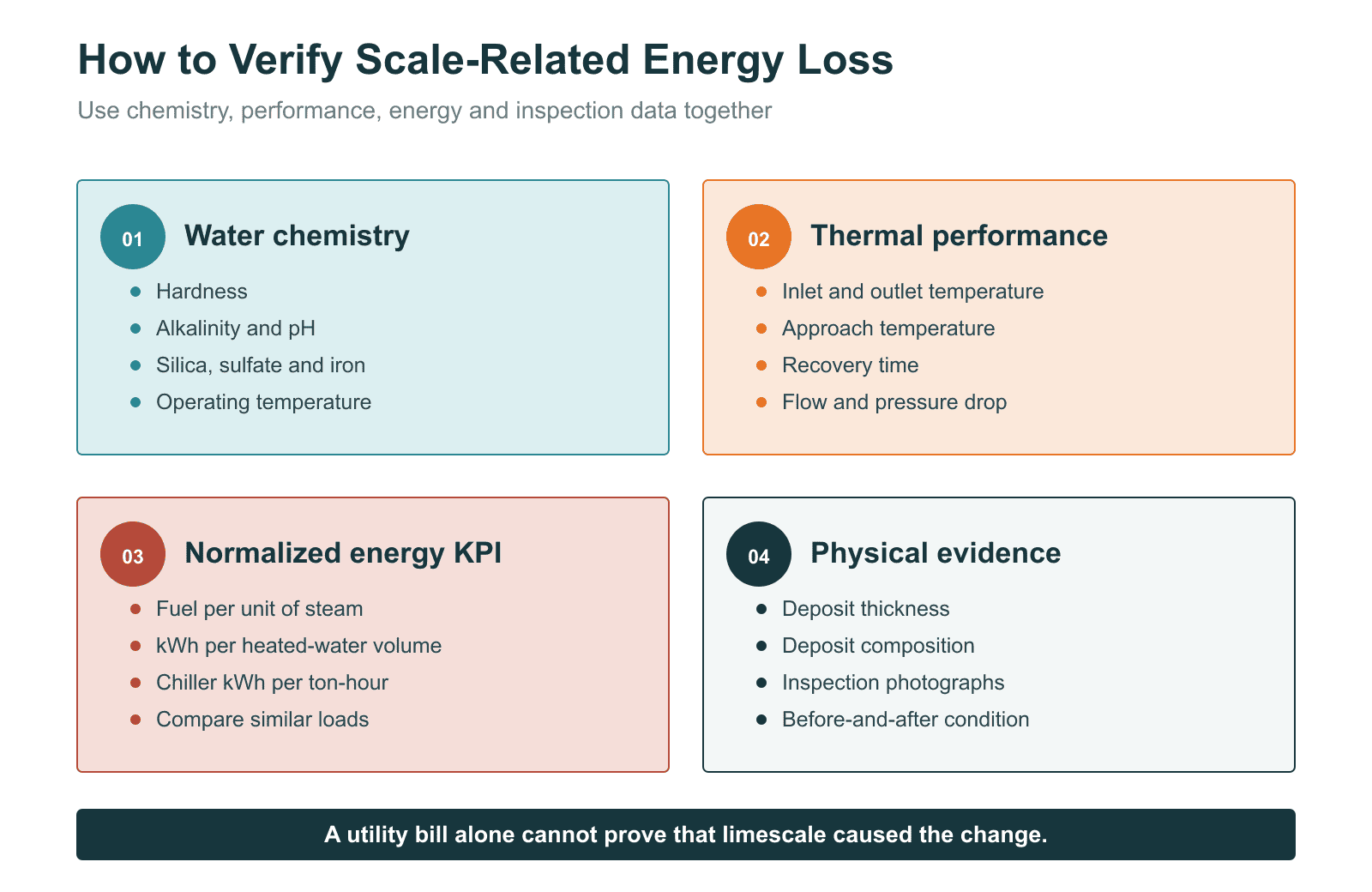
- Test water hardness and chemistry. Start with hardness as mg/L or ppm CaCO3. Add alkalinity, pH, conductivity, silica, sulfate, iron and temperature when the application requires a fuller analysis.
- Establish an energy baseline. Normalize energy against hot-water volume, steam production, process heat duty or cooling ton-hours instead of comparing utility bills alone.
- Inspect thickness and composition. Use a borescope, tube inspection, plate opening or approved service inspection. Analyze the deposit when safety or project value justifies it.
- Clean severe existing deposits. Blockage, unsafe metal temperature or damaged surfaces require immediate cleaning or repair using a method compatible with the metallurgy.
- Select ongoing scale treatment. Match the method to water chemistry, pressure, temperature, flow, equipment design and the required residual hardness.
- Compare normalized performance afterward. Repeat the same KPI under similar operating conditions. If useful output improves for the same energy input, scale was likely part of the loss.
Removing Scale Is Different From Preventing It
First, descaling addresses deposits that already exist. By contrast, prevention reduces the conditions that allow the next hard layer to form. Therefore, an effective plan often uses both jobs at different stages.
| Method | Main Job | Strength | Important Limit |
|---|---|---|---|
| Mechanical or chemical descaling | Remove established deposits | Can restore heavily fouled surfaces | Requires compatible procedures and often downtime |
| Ion-exchange softening | Remove calcium and magnesium | Strong protection where low hardness is required | Needs salt, regeneration, drainage and monitoring |
| Reverse osmosis or demineralization | Remove a broad range of dissolved minerals | Suitable for demanding process water | Produces reject water and needs pretreatment |
| Chemical scale inhibition | Control precipitation and crystal growth | Adjustable for circulating industrial systems | Requires dosing and residual control |
| Physical scale control | Influence scale formation and adhesion without removing hardness | Continuous treatment without salt or routine chemical dosing at the device | Suitability depends on chemistry, flow, temperature and equipment design |
However, severe blockage, damaged metal or unsafe tube temperatures should never wait for gradual treatment. First, correct the immediate condition. Then, address the incoming water so the deposit does not simply return.
Where ScaleDp Fits
More specifically, ScaleDp is a physical scale-control option for residential, commercial and industrial water lines. It is designed to influence calcium-carbonate crystallization and reduce hard-scale adhesion under suitable operating conditions. In addition, the device uses no salt or routine chemical dosing and requires no external electricity for its scale-control function.
However, ScaleDp does not remove calcium and magnesium, so a hardness test after installation may show the same result. Instead, its objective is to change how scale forms and attaches, not to produce softened or demineralized water.
Still, application limits matter. Model and installation-point selection must match pipe size, flow rate, pressure, temperature, water chemistry and the equipment being protected. For example, high-pressure boilers, high-purity processes and systems with strict hardness limits may still need softening, reverse osmosis, demineralization or conventional chemical treatment.
Therefore, buyers can start with the relevant application range:
- Whole-house water descaler for residential hot-water equipment and household water-use points
- Commercial water descaler for hotels, restaurants, laundries, apartments and light commercial systems
- Industrial water descaler for larger heat exchangers, condensers, cooling loops and process lines
- Scale inhibition technology for the intended physical scale-control mechanism

Finally, the strongest evaluation is a baseline-and-follow-up plan. Track the same water chemistry, flow, temperature, pressure drop, cleaning frequency, deposit condition and energy-per-output KPI before and after installation.
Provide the equipment type, water hardness, pipe size, flow rate, pressure, operating temperature and installation photos. ScaleDp can recommend a suitable model and a practical verification plan.
Send Project Data
Frequently Asked Questions
Does Limescale Increase Electricity Consumption?
Yes. On electric equipment, scale adds thermal resistance and can extend element or compressor runtime. Therefore, verify the effect by comparing kWh with the same useful output, such as heated-water volume or cooling ton-hours.
Does Limescale Increase Gas Bills?
It can. Likewise, a scaled gas water heater or boiler may need longer burner operation to deliver the same heat. However, combustion condition, load and controls also affect gas use, so compare fuel with hot-water or steam output.
How Much Energy Does 1 mm of Limescale Waste?
There is no universal percentage. In fact, DOE firetube boiler data shows losses from 2.0% to 7.0% at approximately 0.79 mm, depending on deposit composition. Therefore, other equipment requires its own measurement or suitable published data.
Does Descaling Reduce Energy Consumption?
It can when scale is a meaningful part of the thermal resistance or flow restriction. The result depends on how much deposit is removed and whether other efficiency problems remain.
Does ScaleDp Soften Water?
No. ScaleDp does not remove calcium and magnesium hardness. It is intended to reduce hard-scale formation and adhesion under suitable conditions, so its role differs from ion exchange or reverse osmosis.



